

-
1 basic disease
Психология: основное заболевание -
2 basic disease
мед.фраз. основный заболевание -
3 basic disease
-
4 basic disease
-
5 pension
̘. ̈n. ̘ˑˈpenʃən
1. сущ.
1) пенсия;
пособие to award, grant a pension ≈ давать пенсию to draw, receive a pension ≈ получать пенсию to revoke a pension ≈ отменять выплату пенсии disability pension ≈ пенсия по нетрудоспособности, пенсия по инвалидности old-age pension ≈ пенсия по старости survivor's pension ≈ пенсия (членам семьи) по случаю смерти кормильца
2) пансион
2. гл. назначать пенсию;
субсидировать pension off пенсия - old age /superannuation/ * пенсия по старости - life * пожизненная пенсия - disability /disablement/ * пенсия по нетрудоспособности - to retire on a * уйти на пенсию пособие, субсидия( артистам и т. п.) - to grant a * to smb. назначить пенсию или пособие кому-л. (устаревшее) взятка, плата за услуги назначать пенсию субсидировать пансион - terms with full * стоимость содержания с полным пансионом пансионат (юридическое) совещание членов адвокатской корпорации "Грейз Инн" (тж. * of Gray's Inn) assistance ~ денежное воспомоществование, пенсия по уходу basic ~ основная пенсия basic ~ component основная часть пенсионных выплат (начисляемая за основной социальный статус) basic ~ security гарантии выплаты основной пенсии, пенсионное страхование capital ~ fund основной пенсионный фонд capital ~ savings account сберегательный счет пенсионного капитала change of generation ~ пенсия по возрасту;
пенсия выплачиваемая уволенным в связи с приходом молодого пополнения child's ~ детская пенсия child's ~ пенсия на ребенка children's ~ пансион для детей civil servant's ~ пенсия государственного служащего continued ~ длительный пансион;
непрерывно выплачиваемая пенсия contributory ~ scheme программа пенсионного обеспечения за счет взносов deferred old age ~ отсроченная пенсия по возрасту dependant's ~ пенсия на иждивенца disablement ~ пенсия по инвалидности disablement ~ пособие по инвалидности early old age ~ досрочная пенсия по старости early retirement ~ пенсия досрочно вышедшего в отставку early retirement ~ пенсия при досрочной отставке earnings-related ~ пенсия, зависящая от заработка earnings-related ~ пенсия начисляемая в зависимости от заработной платы (на последнем месте работы или в соответствии с установленным порядком) employment accident ~ пенсия по случаю производственной травмы employment ~ пенсия employment ~ cover охват пенсионным обеспечением employment ~ index пенсионный индекс наемных работников entitlement to ~ право на получение пенсии farm closure ~ пенсия в связи с разорением фермы flat-rate ~ фиксированная ставка пенсии flexible ~ arrangements гибкая пенсионная система front veteran's ~ пенсия ветерана-фронтовика full ~ полная пенсия full-scale national ~ государственная пенсия в полном размере government ~ государственная пенсия income-related ~ пенсия, связанная с доходом indexed ~ scheme программа пенсионного обеспечения с индексацией individual early invalidity ~ индивидуальная досрочная пенсия по инвалидности instalment ~ выплата пенсии частями invalidity ~ пенсия по инвалидности labour market ~ пенсия на рынке труда maintenace of the value of the ~ поддержание ценности пенсии (учитывая либо индекс роста цен, либо индекс роста зарплаты) minimum old-age ~ минимальный размер пенсии по старости minimum ~ минимальная пенсия national old age invalidity and unemployment ~ национальная пенсия по старости инвалидности и безработице national ~ государственная пенсия national ~ национальная пенсия noncontributory ~ scheme система пенсионного обеспечения не на основе взносов occupational ~ профессиональная пенсия occupational ~ scheme программа пенсионного обеспечения на рынке труда occupational ~ scheme система профессиональных пенсий occurence of ~ contingency наступление пенсионного страхового случая old age ~ соц. пенсия по старости old-age ~ пенсия по старости orphan's ~ сиротская пенсия overall ~ общая пенсия;
предельная пенсия overall ~ полная пенсия parallel ~ параллельная пенсия part-time ~ неполная пенсия partial invalidity ~ неполная пенсия по инвалидности;
частичная пенсия по инвалидности pay-as-you-go ~ system пенсионная система использующая все поступающие взносы в фонд на выплату пенсии за текущий период pension арендная плата ~ давать субсидию ~ ежегодная плата, аннуитет ~ назначать пенсию;
субсидировать;
pension off увольнять на пенсию ~ назначать пенсию ~ пансион ~ пансион ~ пенсия;
пособие ~ пенсия ~ пособие ~ субсидировать ~ субсидия ~ for accident at work пособие по случаю производственной травмы ~ in respect of occupational disease пособие по случаю профессионального заболевания ~ назначать пенсию;
субсидировать;
pension off увольнять на пенсию personal ~ персональная пенсия premium capital ~ пенсия из фонда социального обеспечения retirement ~ пенсия retirement ~ пенсия за выслугу лет retirement ~ пенсия по возрасту retirement ~ пенсия по старости retirment ~ пенсия по старости right to a ~ право на пенсию self-employed person's ~ пенсия работающего на себя social insurance ~ пенсия из фонда социального страхования social ~ социальная пенсия social security ~ пенсия из фонда социального обеспечения spouse ~ пенсия, выплачиваемая мужу spouse ~ пенсия, выплачиваемая жене spouse's ~ пенсия супруга( супруги) starting ~ начальная пенсия state ~ государственная пенсия supplementary ~ добавка к пенсии supplementary ~ дополнительная пенсия surviving dependants' ~ пенсия пережившим иждивенцам surviving spouse's ~ пенсия вдовы (вдовца) survivor's ~ пенсия лица пережившего кормильца survivor's ~ пенсия по случаю потери кормильца total ~ общая пенсия unemployment ~ пенсия по безработице welfare ~ пенсия из фондов социального обеспечения widow's ~ пенсия вдове widow's ~ пенсия вдовы widower's ~ пенсия вдовца widower's ~ пенсия вдовцу -
6 Historical Portugal
Before Romans described western Iberia or Hispania as "Lusitania," ancient Iberians inhabited the land. Phoenician and Greek trading settlements grew up in the Tagus estuary area and nearby coasts. Beginning around 202 BCE, Romans invaded what is today southern Portugal. With Rome's defeat of Carthage, Romans proceeded to conquer and rule the western region north of the Tagus, which they named Roman "Lusitania." In the fourth century CE, as Rome's rule weakened, the area experienced yet another invasion—Germanic tribes, principally the Suevi, who eventually were Christianized. During the sixth century CE, the Suevi kingdom was superseded by yet another Germanic tribe—the Christian Visigoths.A major turning point in Portugal's history came in 711, as Muslim armies from North Africa, consisting of both Arab and Berber elements, invaded the Iberian Peninsula from across the Straits of Gibraltar. They entered what is now Portugal in 714, and proceeded to conquer most of the country except for the far north. For the next half a millennium, Islam and Muslim presence in Portugal left a significant mark upon the politics, government, language, and culture of the country.Islam, Reconquest, and Portugal Created, 714-1140The long frontier struggle between Muslim invaders and Christian communities in the north of the Iberian peninsula was called the Reconquista (Reconquest). It was during this struggle that the first dynasty of Portuguese kings (Burgundian) emerged and the independent monarchy of Portugal was established. Christian forces moved south from what is now the extreme north of Portugal and gradually defeated Muslim forces, besieging and capturing towns under Muslim sway. In the ninth century, as Christian forces slowly made their way southward, Christian elements were dominant only in the area between Minho province and the Douro River; this region became known as "territorium Portu-calense."In the 11th century, the advance of the Reconquest quickened as local Christian armies were reinforced by crusading knights from what is now France and England. Christian forces took Montemor (1034), at the Mondego River; Lamego (1058); Viseu (1058); and Coimbra (1064). In 1095, the king of Castile and Léon granted the country of "Portu-cale," what became northern Portugal, to a Burgundian count who had emigrated from France. This was the foundation of Portugal. In 1139, a descendant of this count, Afonso Henriques, proclaimed himself "King of Portugal." He was Portugal's first monarch, the "Founder," and the first of the Burgundian dynasty, which ruled until 1385.The emergence of Portugal in the 12th century as a separate monarchy in Iberia occurred before the Christian Reconquest of the peninsula. In the 1140s, the pope in Rome recognized Afonso Henriques as king of Portugal. In 1147, after a long, bloody siege, Muslim-occupied Lisbon fell to Afonso Henriques's army. Lisbon was the greatest prize of the 500-year war. Assisting this effort were English crusaders on their way to the Holy Land; the first bishop of Lisbon was an Englishman. When the Portuguese captured Faro and Silves in the Algarve province in 1248-50, the Reconquest of the extreme western portion of the Iberian peninsula was complete—significantly, more than two centuries before the Spanish crown completed the Reconquest of the eastern portion by capturing Granada in 1492.Consolidation and Independence of Burgundian Portugal, 1140-1385Two main themes of Portugal's early existence as a monarchy are the consolidation of control over the realm and the defeat of a Castil-ian threat from the east to its independence. At the end of this period came the birth of a new royal dynasty (Aviz), which prepared to carry the Christian Reconquest beyond continental Portugal across the straits of Gibraltar to North Africa. There was a variety of motives behind these developments. Portugal's independent existence was imperiled by threats from neighboring Iberian kingdoms to the north and east. Politics were dominated not only by efforts against the Muslims inPortugal (until 1250) and in nearby southern Spain (until 1492), but also by internecine warfare among the kingdoms of Castile, Léon, Aragon, and Portugal. A final comeback of Muslim forces was defeated at the battle of Salado (1340) by allied Castilian and Portuguese forces. In the emerging Kingdom of Portugal, the monarch gradually gained power over and neutralized the nobility and the Church.The historic and commonplace Portuguese saying "From Spain, neither a good wind nor a good marriage" was literally played out in diplomacy and war in the late 14th-century struggles for mastery in the peninsula. Larger, more populous Castile was pitted against smaller Portugal. Castile's Juan I intended to force a union between Castile and Portugal during this era of confusion and conflict. In late 1383, Portugal's King Fernando, the last king of the Burgundian dynasty, suddenly died prematurely at age 38, and the Master of Aviz, Portugal's most powerful nobleman, took up the cause of independence and resistance against Castile's invasion. The Master of Aviz, who became King João I of Portugal, was able to obtain foreign assistance. With the aid of English archers, Joao's armies defeated the Castilians in the crucial battle of Aljubarrota, on 14 August 1385, a victory that assured the independence of the Portuguese monarchy from its Castilian nemesis for several centuries.Aviz Dynasty and Portugal's First Overseas Empire, 1385-1580The results of the victory at Aljubarrota, much celebrated in Portugal's art and monuments, and the rise of the Aviz dynasty also helped to establish a new merchant class in Lisbon and Oporto, Portugal's second city. This group supported King João I's program of carrying the Reconquest to North Africa, since it was interested in expanding Portugal's foreign commerce and tapping into Muslim trade routes and resources in Africa. With the Reconquest against the Muslims completed in Portugal and the threat from Castile thwarted for the moment, the Aviz dynasty launched an era of overseas conquest, exploration, and trade. These efforts dominated Portugal's 15th and 16th centuries.The overseas empire and age of Discoveries began with Portugal's bold conquest in 1415 of the Moroccan city of Ceuta. One royal member of the 1415 expedition was young, 21-year-old Prince Henry, later known in history as "Prince Henry the Navigator." His part in the capture of Ceuta won Henry his knighthood and began Portugal's "Marvelous Century," during which the small kingdom was counted as a European and world power of consequence. Henry was the son of King João I and his English queen, Philippa of Lancaster, but he did not inherit the throne. Instead, he spent most of his life and his fortune, and that of the wealthy military Order of Christ, on various imperial ventures and on voyages of exploration down the African coast and into the Atlantic. While mythology has surrounded Henry's controversial role in the Discoveries, and this role has been exaggerated, there is no doubt that he played a vital part in the initiation of Portugal's first overseas empire and in encouraging exploration. He was naturally curious, had a sense of mission for Portugal, and was a strong leader. He also had wealth to expend; at least a third of the African voyages of the time were under his sponsorship. If Prince Henry himself knew little science, significant scientific advances in navigation were made in his day.What were Portugal's motives for this new imperial effort? The well-worn historical cliche of "God, Glory, and Gold" can only partly explain the motivation of a small kingdom with few natural resources and barely 1 million people, which was greatly outnumbered by the other powers it confronted. Among Portuguese objectives were the desire to exploit known North African trade routes and resources (gold, wheat, leather, weaponry, and other goods that were scarce in Iberia); the need to outflank the Muslim world in the Mediterranean by sailing around Africa, attacking Muslims en route; and the wish to ally with Christian kingdoms beyond Africa. This enterprise also involved a strategy of breaking the Venetian spice monopoly by trading directly with the East by means of discovering and exploiting a sea route around Africa to Asia. Besides the commercial motives, Portugal nurtured a strong crusading sense of Christian mission, and various classes in the kingdom saw an opportunity for fame and gain.By the time of Prince Henry's death in 1460, Portugal had gained control of the Atlantic archipelagos of the Azores and Madeiras, begun to colonize the Cape Verde Islands, failed to conquer the Canary Islands from Castile, captured various cities on Morocco's coast, and explored as far as Senegal, West Africa, down the African coast. By 1488, Bar-tolomeu Dias had rounded the Cape of Good Hope in South Africa and thereby discovered the way to the Indian Ocean.Portugal's largely coastal African empire and later its fragile Asian empire brought unexpected wealth but were purchased at a high price. Costs included wars of conquest and defense against rival powers, manning the far-flung navel and trade fleets and scattered castle-fortresses, and staffing its small but fierce armies, all of which entailed a loss of skills and population to maintain a scattered empire. Always short of capital, the monarchy became indebted to bankers. There were many defeats beginning in the 16th century at the hands of the larger imperial European monarchies (Spain, France, England, and Holland) and many attacks on Portugal and its strung-out empire. Typically, there was also the conflict that arose when a tenuously held world empire that rarely if ever paid its way demanded finance and manpower Portugal itself lacked.The first 80 years of the glorious imperial era, the golden age of Portugal's imperial power and world influence, was an African phase. During 1415-88, Portuguese navigators and explorers in small ships, some of them caravelas (caravels), explored the treacherous, disease-ridden coasts of Africa from Morocco to South Africa beyond the Cape of Good Hope. By the 1470s, the Portuguese had reached the Gulf of Guinea and, in the early 1480s, what is now Angola. Bartolomeu Dias's extraordinary voyage of 1487-88 to South Africa's coast and the edge of the Indian Ocean convinced Portugal that the best route to Asia's spices and Christians lay south, around the tip of southern Africa. Between 1488 and 1495, there was a hiatus caused in part by domestic conflict in Portugal, discussion of resources available for further conquests beyond Africa in Asia, and serious questions as to Portugal's capacity to reach beyond Africa. In 1495, King Manuel and his council decided to strike for Asia, whatever the consequences. In 1497-99, Vasco da Gama, under royal orders, made the epic two-year voyage that discovered the sea route to western India (Asia), outflanked Islam and Venice, and began Portugal's Asian empire. Within 50 years, Portugal had discovered and begun the exploitation of its largest colony, Brazil, and set up forts and trading posts from the Middle East (Aden and Ormuz), India (Calicut, Goa, etc.), Malacca, and Indonesia to Macau in China.By the 1550s, parts of its largely coastal, maritime trading post empire from Morocco to the Moluccas were under siege from various hostile forces, including Muslims, Christians, and Hindi. Although Moroccan forces expelled the Portuguese from the major coastal cities by 1550, the rival European monarchies of Castile (Spain), England, France, and later Holland began to seize portions of her undermanned, outgunned maritime empire.In 1580, Phillip II of Spain, whose mother was a Portuguese princess and who had a strong claim to the Portuguese throne, invaded Portugal, claimed the throne, and assumed control over the realm and, by extension, its African, Asian, and American empires. Phillip II filled the power vacuum that appeared in Portugal following the loss of most of Portugal's army and its young, headstrong King Sebastião in a disastrous war in Morocco. Sebastiao's death in battle (1578) and the lack of a natural heir to succeed him, as well as the weak leadership of the cardinal who briefly assumed control in Lisbon, led to a crisis that Spain's strong monarch exploited. As a result, Portugal lost its independence to Spain for a period of 60 years.Portugal under Spanish Rule, 1580-1640Despite the disastrous nature of Portugal's experience under Spanish rule, "The Babylonian Captivity" gave birth to modern Portuguese nationalism, its second overseas empire, and its modern alliance system with England. Although Spain allowed Portugal's weakened empire some autonomy, Spanish rule in Portugal became increasingly burdensome and unacceptable. Spain's ambitious imperial efforts in Europe and overseas had an impact on the Portuguese as Spain made greater and greater demands on its smaller neighbor for manpower and money. Portugal's culture underwent a controversial Castilianization, while its empire became hostage to Spain's fortunes. New rival powers England, France, and Holland attacked and took parts of Spain's empire and at the same time attacked Portugal's empire, as well as the mother country.Portugal's empire bore the consequences of being attacked by Spain's bitter enemies in what was a form of world war. Portuguese losses were heavy. By 1640, Portugal had lost most of its Moroccan cities as well as Ceylon, the Moluccas, and sections of India. With this, Portugal's Asian empire was gravely weakened. Only Goa, Damão, Diu, Bombay, Timor, and Macau remained and, in Brazil, Dutch forces occupied the northeast.On 1 December 1640, long commemorated as a national holiday, Portuguese rebels led by the duke of Braganza overthrew Spanish domination and took advantage of Spanish weakness following a more serious rebellion in Catalonia. Portugal regained independence from Spain, but at a price: dependence on foreign assistance to maintain its independence in the form of the renewal of the alliance with England.Restoration and Second Empire, 1640-1822Foreign affairs and empire dominated the restoration era and aftermath, and Portugal again briefly enjoyed greater European power and prestige. The Anglo-Portuguese Alliance was renewed and strengthened in treaties of 1642, 1654, and 1661, and Portugal's independence from Spain was underwritten by English pledges and armed assistance. In a Luso-Spanish treaty of 1668, Spain recognized Portugal's independence. Portugal's alliance with England was a marriage of convenience and necessity between two monarchies with important religious, cultural, and social differences. In return for legal, diplomatic, and trade privileges, as well as the use during war and peace of Portugal's great Lisbon harbor and colonial ports for England's navy, England pledged to protect Portugal and its scattered empire from any attack. The previously cited 17th-century alliance treaties were renewed later in the Treaty of Windsor, signed in London in 1899. On at least 10 different occasions after 1640, and during the next two centuries, England was central in helping prevent or repel foreign invasions of its ally, Portugal.Portugal's second empire (1640-1822) was largely Brazil-oriented. Portuguese colonization, exploitation of wealth, and emigration focused on Portuguese America, and imperial revenues came chiefly from Brazil. Between 1670 and 1740, Portugal's royalty and nobility grew wealthier on funds derived from Brazilian gold, diamonds, sugar, tobacco, and other crops, an enterprise supported by the Atlantic slave trade and the supply of African slave labor from West Africa and Angola. Visitors today can see where much of that wealth was invested: Portugal's rich legacy of monumental architecture. Meanwhile, the African slave trade took a toll in Angola and West Africa.In continental Portugal, absolutist monarchy dominated politics and government, and there was a struggle for position and power between the monarchy and other institutions, such as the Church and nobility. King José I's chief minister, usually known in history as the marquis of Pombal (ruled 1750-77), sharply suppressed the nobility and theChurch (including the Inquisition, now a weak institution) and expelled the Jesuits. Pombal also made an effort to reduce economic dependence on England, Portugal's oldest ally. But his successes did not last much beyond his disputed time in office.Beginning in the late 18th century, the European-wide impact of the French Revolution and the rise of Napoleon placed Portugal in a vulnerable position. With the monarchy ineffectively led by an insane queen (Maria I) and her indecisive regent son (João VI), Portugal again became the focus of foreign ambition and aggression. With England unable to provide decisive assistance in time, France—with Spain's consent—invaded Portugal in 1807. As Napoleon's army under General Junot entered Lisbon meeting no resistance, Portugal's royal family fled on a British fleet to Brazil, where it remained in exile until 1821. In the meantime, Portugal's overseas empire was again under threat. There was a power vacuum as the monarch was absent, foreign armies were present, and new political notions of liberalism and constitutional monarchy were exciting various groups of citizens.Again England came to the rescue, this time in the form of the armies of the duke of Wellington. Three successive French invasions of Portugal were defeated and expelled, and Wellington succeeded in carrying the war against Napoleon across the Portuguese frontier into Spain. The presence of the English army, the new French-born liberal ideas, and the political vacuum combined to create revolutionary conditions. The French invasions and the peninsular wars, where Portuguese armed forces played a key role, marked the beginning of a new era in politics.Liberalism and Constitutional Monarchy, 1822-1910During 1807-22, foreign invasions, war, and civil strife over conflicting political ideas gravely damaged Portugal's commerce, economy, and novice industry. The next terrible blow was the loss of Brazil in 1822, the jewel in the imperial crown. Portugal's very independence seemed to be at risk. In vain, Portugal sought to resist Brazilian independence by force, but in 1825 it formally acknowledged Brazilian independence by treaty.Portugal's slow recovery from the destructive French invasions and the "war of independence" was complicated by civil strife over the form of constitutional monarchy that best suited Portugal. After struggles over these issues between 1820 and 1834, Portugal settled somewhat uncertainly into a moderate constitutional monarchy whose constitution (Charter of 1826) lent it strong political powers to exert a moderating influence between the executive and legislative branches of the government. It also featured a new upper middle class based on land ownership and commerce; a Catholic Church that, although still important, lived with reduced privileges and property; a largely African (third) empire to which Lisbon and Oporto devoted increasing spiritual and material resources, starting with the liberal imperial plans of 1836 and 1851, and continuing with the work of institutions like the Lisbon Society of Geography (established 1875); and a mass of rural peasants whose bonds to the land weakened after 1850 and who began to immigrate in increasing numbers to Brazil and North America.Chronic military intervention in national politics began in 19th-century Portugal. Such intervention, usually commencing with coups or pronunciamentos (military revolts), was a shortcut to the spoils of political office and could reflect popular discontent as well as the power of personalities. An early example of this was the 1817 golpe (coup) attempt of General Gomes Freire against British military rule in Portugal before the return of King João VI from Brazil. Except for a more stable period from 1851 to 1880, military intervention in politics, or the threat thereof, became a feature of the constitutional monarchy's political life, and it continued into the First Republic and the subsequent Estado Novo.Beginning with the Regeneration period (1851-80), Portugal experienced greater political stability and economic progress. Military intervention in politics virtually ceased; industrialization and construction of railroads, roads, and bridges proceeded; two political parties (Regenerators and Historicals) worked out a system of rotation in power; and leading intellectuals sparked a cultural revival in several fields. In 19th-century literature, there was a new golden age led by such figures as Alexandre Herculano (historian), Eça de Queirós (novelist), Almeida Garrett (playwright and essayist), Antero de Quental (poet), and Joaquim Oliveira Martins (historian and social scientist). In its third overseas empire, Portugal attempted to replace the slave trade and slavery with legitimate economic activities; to reform the administration; and to expand Portuguese holdings beyond coastal footholds deep into the African hinterlands in West, West Central, and East Africa. After 1841, to some extent, and especially after 1870, colonial affairs, combined with intense nationalism, pressures for economic profit in Africa, sentiment for national revival, and the drift of European affairs would make or break Lisbon governments.Beginning with the political crisis that arose out of the "English Ultimatum" affair of January 1890, the monarchy became discredtted and identified with the poorly functioning government, political parties splintered, and republicanism found more supporters. Portugal participated in the "Scramble for Africa," expanding its African holdings, but failed to annex territory connecting Angola and Mozambique. A growing foreign debt and state bankruptcy as of the early 1890s damaged the constitutional monarchy's reputation, despite the efforts of King Carlos in diplomacy, the renewal of the alliance in the Windsor Treaty of 1899, and the successful if bloody colonial wars in the empire (1880-97). Republicanism proclaimed that Portugal's weak economy and poor society were due to two historic institutions: the monarchy and the Catholic Church. A republic, its stalwarts claimed, would bring greater individual liberty; efficient, if more decentralized government; and a stronger colonial program while stripping the Church of its role in both society and education.As the monarchy lost support and republicans became more aggressive, violence increased in politics. King Carlos I and his heir Luís were murdered in Lisbon by anarchist-republicans on 1 February 1908. Following a military and civil insurrection and fighting between monarchist and republican forces, on 5 October 1910, King Manuel II fled Portugal and a republic was proclaimed.First Parliamentary Republic, 1910-26Portugal's first attempt at republican government was the most unstable, turbulent parliamentary republic in the history of 20th-century Western Europe. During a little under 16 years of the republic, there were 45 governments, a number of legislatures that did not complete normal terms, military coups, and only one president who completed his four-year term in office. Portuguese society was poorly prepared for this political experiment. Among the deadly legacies of the monarchy were a huge public debt; a largely rural, apolitical, and illiterate peasant population; conflict over the causes of the country's misfortunes; and lack of experience with a pluralist, democratic system.The republic had some talented leadership but lacked popular, institutional, and economic support. The 1911 republican constitution established only a limited democracy, as only a small portion of the adult male citizenry was eligible to vote. In a country where the majority was Catholic, the republic passed harshly anticlerical laws, and its institutions and supporters persecuted both the Church and its adherents. During its brief disjointed life, the First Republic drafted important reform plans in economic, social, and educational affairs; actively promoted development in the empire; and pursued a liberal, generous foreign policy. Following British requests for Portugal's assistance in World War I, Portugal entered the war on the Allied side in March 1916 and sent armies to Flanders and Portuguese Africa. Portugal's intervention in that conflict, however, was too costly in many respects, and the ultimate failure of the republic in part may be ascribed to Portugal's World War I activities.Unfortunately for the republic, its time coincided with new threats to Portugal's African possessions: World War I, social and political demands from various classes that could not be reconciled, excessive military intervention in politics, and, in particular, the worst economic and financial crisis Portugal had experienced since the 16th and 17th centuries. After the original Portuguese Republican Party (PRP, also known as the "Democrats") splintered into three warring groups in 1912, no true multiparty system emerged. The Democrats, except for only one or two elections, held an iron monopoly of electoral power, and political corruption became a major issue. As extreme right-wing dictatorships elsewhere in Europe began to take power in Italy (1922), neighboring Spain (1923), and Greece (1925), what scant popular support remained for the republic collapsed. Backed by a right-wing coalition of landowners from Alentejo, clergy, Coimbra University faculty and students, Catholic organizations, and big business, career military officers led by General Gomes da Costa executed a coup on 28 May 1926, turned out the last republican government, and established a military government.The Estado Novo (New State), 1926-74During the military phase (1926-32) of the Estado Novo, professional military officers, largely from the army, governed and administered Portugal and held key cabinet posts, but soon discovered that the military possessed no magic formula that could readily solve the problems inherited from the First Republic. Especially during the years 1926-31, the military dictatorship, even with its political repression of republican activities and institutions (military censorship of the press, political police action, and closure of the republic's rowdy parliament), was characterized by similar weaknesses: personalism and factionalism; military coups and political instability, including civil strife and loss of life; state debt and bankruptcy; and a weak economy. "Barracks parliamentarism" was not an acceptable alternative even to the "Nightmare Republic."Led by General Óscar Carmona, who had replaced and sent into exile General Gomes da Costa, the military dictatorship turned to a civilian expert in finance and economics to break the budget impasse and bring coherence to the disorganized system. Appointed minister of finance on 27 April 1928, the Coimbra University Law School professor of economics Antônio de Oliveira Salazar (1889-1970) first reformed finance, helped balance the budget, and then turned to other concerns as he garnered extraordinary governing powers. In 1930, he was appointed interim head of another key ministry (Colonies) and within a few years had become, in effect, a civilian dictator who, with the military hierarchy's support, provided the government with coherence, a program, and a set of policies.For nearly 40 years after he was appointed the first civilian prime minister in 1932, Salazar's personality dominated the government. Unlike extreme right-wing dictators elsewhere in Europe, Salazar was directly appointed by the army but was never endorsed by a popular political party, street militia, or voter base. The scholarly, reclusive former Coimbra University professor built up what became known after 1932 as the Estado Novo ("New State"), which at the time of its overthrow by another military coup in 1974, was the longest surviving authoritarian regime in Western Europe. The system of Salazar and the largely academic and technocratic ruling group he gathered in his cabinets was based on the central bureaucracy of the state, which was supported by the president of the republic—always a senior career military officer, General Óscar Carmona (1928-51), General Craveiro Lopes (1951-58), and Admiral Américo Tómaz (1958-74)—and the complicity of various institutions. These included a rubber-stamp legislature called the National Assembly (1935-74) and a political police known under various names: PVDE (1932-45), PIDE (1945-69),and DGS (1969-74). Other defenders of the Estado Novo security were paramilitary organizations such as the National Republican Guard (GNR); the Portuguese Legion (PL); and the Portuguese Youth [Movement]. In addition to censorship of the media, theater, and books, there was political repression and a deliberate policy of depoliticization. All political parties except for the approved movement of regime loyalists, the União Nacional or (National Union), were banned.The most vigorous and more popular period of the New State was 1932-44, when the basic structures were established. Never monolithic or entirely the work of one person (Salazar), the New State was constructed with the assistance of several dozen top associates who were mainly academics from law schools, some technocrats with specialized skills, and a handful of trusted career military officers. The 1933 Constitution declared Portugal to be a "unitary, corporative Republic," and pressures to restore the monarchy were resisted. Although some of the regime's followers were fascists and pseudofascists, many more were conservative Catholics, integralists, nationalists, and monarchists of different varieties, and even some reactionary republicans. If the New State was authoritarian, it was not totalitarian and, unlike fascism in Benito Mussolini's Italy or Adolf Hitler's Germany, it usually employed the minimum of violence necessary to defeat what remained a largely fractious, incoherent opposition.With the tumultuous Second Republic and the subsequent civil war in nearby Spain, the regime felt threatened and reinforced its defenses. During what Salazar rightly perceived as a time of foreign policy crisis for Portugal (1936-45), he assumed control of the Ministry of Foreign Affairs. From there, he pursued four basic foreign policy objectives: supporting the Nationalist rebels of General Francisco Franco in the Spanish Civil War (1936-39) and concluding defense treaties with a triumphant Franco; ensuring that General Franco in an exhausted Spain did not enter World War II on the Axis side; maintaining Portuguese neutrality in World War II with a post-1942 tilt toward the Allies, including granting Britain and the United States use of bases in the Azores Islands; and preserving and protecting Portugal's Atlantic Islands and its extensive, if poor, overseas empire in Africa and Asia.During the middle years of the New State (1944-58), many key Salazar associates in government either died or resigned, and there was greater social unrest in the form of unprecedented strikes and clandestine Communist activities, intensified opposition, and new threatening international pressures on Portugal's overseas empire. During the earlier phase of the Cold War (1947-60), Portugal became a steadfast, if weak, member of the US-dominated North Atlantic Treaty Organization alliance and, in 1955, with American support, Portugal joined the United Nations (UN). Colonial affairs remained a central concern of the regime. As of 1939, Portugal was the third largest colonial power in the world and possessed territories in tropical Africa (Angola, Mozambique, Guinea-Bissau, and São Tomé and Príncipe Islands) and the remnants of its 16th-century empire in Asia (Goa, Damão, Diu, East Timor, and Macau). Beginning in the early 1950s, following the independence of India in 1947, Portugal resisted Indian pressures to decolonize Portuguese India and used police forces to discourage internal opposition in its Asian and African colonies.The later years of the New State (1958-68) witnessed the aging of the increasingly isolated but feared Salazar and new threats both at home and overseas. Although the regime easily overcame the brief oppositionist threat from rival presidential candidate General Humberto Delgado in the spring of 1958, new developments in the African and Asian empires imperiled the authoritarian system. In February 1961, oppositionists hijacked the Portuguese ocean liner Santa Maria and, in following weeks, African insurgents in northern Angola, although they failed to expel the Portuguese, gained worldwide media attention, discredited the New State, and began the 13-year colonial war. After thwarting a dissident military coup against his continued leadership, Salazar and his ruling group mobilized military repression in Angola and attempted to develop the African colonies at a faster pace in order to ensure Portuguese control. Meanwhile, the other European colonial powers (Britain, France, Belgium, and Spain) rapidly granted political independence to their African territories.At the time of Salazar's removal from power in September 1968, following a stroke, Portugal's efforts to maintain control over its colonies appeared to be successful. President Americo Tomás appointed Dr. Marcello Caetano as Salazar's successor as prime minister. While maintaining the New State's basic structures, and continuing the regime's essential colonial policy, Caetano attempted wider reforms in colonial administration and some devolution of power from Lisbon, as well as more freedom of expression in Lisbon. Still, a great deal of the budget was devoted to supporting the wars against the insurgencies in Africa. Meanwhile in Asia, Portuguese India had fallen when the Indian army invaded in December 1961. The loss of Goa was a psychological blow to the leadership of the New State, and of the Asian empire only East Timor and Macau remained.The Caetano years (1968-74) were but a hiatus between the waning Salazar era and a new regime. There was greater political freedom and rapid economic growth (5-6 percent annually to late 1973), but Caetano's government was unable to reform the old system thoroughly and refused to consider new methods either at home or in the empire. In the end, regime change came from junior officers of the professional military who organized the Armed Forces Movement (MFA) against the Caetano government. It was this group of several hundred officers, mainly in the army and navy, which engineered a largely bloodless coup in Lisbon on 25 April 1974. Their unexpected action brought down the 48-year-old New State and made possible the eventual establishment and consolidation of democratic governance in Portugal, as well as a reorientation of the country away from the Atlantic toward Europe.Revolution of Carnations, 1974-76Following successful military operations of the Armed Forces Movement against the Caetano government, Portugal experienced what became known as the "Revolution of Carnations." It so happened that during the rainy week of the military golpe, Lisbon flower shops were featuring carnations, and the revolutionaries and their supporters adopted the red carnation as the common symbol of the event, as well as of the new freedom from dictatorship. The MFA, whose leaders at first were mostly little-known majors and captains, proclaimed a three-fold program of change for the new Portugal: democracy; decolonization of the overseas empire, after ending the colonial wars; and developing a backward economy in the spirit of opportunity and equality. During the first 24 months after the coup, there was civil strife, some anarchy, and a power struggle. With the passing of the Estado Novo, public euphoria burst forth as the new provisional military government proclaimed the freedoms of speech, press, and assembly, and abolished censorship, the political police, the Portuguese Legion, Portuguese Youth, and other New State organizations, including the National Union. Scores of political parties were born and joined the senior political party, the Portuguese Community Party (PCP), and the Socialist Party (PS), founded shortly before the coup.Portugal's Revolution of Carnations went through several phases. There was an attempt to take control by radical leftists, including the PCP and its allies. This was thwarted by moderate officers in the army, as well as by the efforts of two political parties: the PS and the Social Democrats (PPD, later PSD). The first phase was from April to September 1974. Provisional president General Antonio Spínola, whose 1974 book Portugal and the Future had helped prepare public opinion for the coup, met irresistible leftist pressures. After Spinola's efforts to avoid rapid decolonization of the African empire failed, he resigned in September 1974. During the second phase, from September 1974 to March 1975, radical military officers gained control, but a coup attempt by General Spínola and his supporters in Lisbon in March 1975 failed and Spínola fled to Spain.In the third phase of the Revolution, March-November 1975, a strong leftist reaction followed. Farm workers occupied and "nationalized" 1.1 million hectares of farmland in the Alentejo province, and radical military officers in the provisional government ordered the nationalization of Portuguese banks (foreign banks were exempted), utilities, and major industries, or about 60 percent of the economic system. There were power struggles among various political parties — a total of 50 emerged—and in the streets there was civil strife among labor, military, and law enforcement groups. A constituent assembly, elected on 25 April 1975, in Portugal's first free elections since 1926, drafted a democratic constitution. The Council of the Revolution (CR), briefly a revolutionary military watchdog committee, was entrenched as part of the government under the constitution, until a later revision. During the chaotic year of 1975, about 30 persons were killed in political frays while unstable provisional governments came and went. On 25 November 1975, moderate military forces led by Colonel Ramalho Eanes, who later was twice elected president of the republic (1976 and 1981), defeated radical, leftist military groups' revolutionary conspiracies.In the meantime, Portugal's scattered overseas empire experienced a precipitous and unprepared decolonization. One by one, the former colonies were granted and accepted independence—Guinea-Bissau (September 1974), Cape Verde Islands (July 1975), and Mozambique (July 1975). Portugal offered to turn over Macau to the People's Republic of China, but the offer was refused then and later negotiations led to the establishment of a formal decolonization or hand-over date of 1999. But in two former colonies, the process of decolonization had tragic results.In Angola, decolonization negotiations were greatly complicated by the fact that there were three rival nationalist movements in a struggle for power. The January 1975 Alvor Agreement signed by Portugal and these three parties was not effectively implemented. A bloody civil war broke out in Angola in the spring of 1975 and, when Portuguese armed forces withdrew and declared that Angola was independent on 11 November 1975, the bloodshed only increased. Meanwhile, most of the white Portuguese settlers from Angola and Mozambique fled during the course of 1975. Together with African refugees, more than 600,000 of these retornados ("returned ones") went by ship and air to Portugal and thousands more to Namibia, South Africa, Brazil, Canada, and the United States.The second major decolonization disaster was in Portugal's colony of East Timor in the Indonesian archipelago. Portugal's capacity to supervise and control a peaceful transition to independence in this isolated, neglected colony was limited by the strength of giant Indonesia, distance from Lisbon, and Portugal's revolutionary disorder and inability to defend Timor. In early December 1975, before Portugal granted formal independence and as one party, FRETILIN, unilaterally declared East Timor's independence, Indonesia's armed forces invaded, conquered, and annexed East Timor. Indonesian occupation encountered East Timorese resistance, and a heavy loss of life followed. The East Timor question remained a contentious international issue in the UN, as well as in Lisbon and Jakarta, for more than 20 years following Indonesia's invasion and annexation of the former colony of Portugal. Major changes occurred, beginning in 1998, after Indonesia underwent a political revolution and allowed a referendum in East Timor to decide that territory's political future in August 1999. Most East Timorese chose independence, but Indonesian forces resisted that verdict untilUN intervention in September 1999. Following UN rule for several years, East Timor attained full independence on 20 May 2002.Consolidation of Democracy, 1976-2000After several free elections and record voter turnouts between 25 April 1975 and June 1976, civil war was averted and Portugal's second democratic republic began to stabilize. The MFA was dissolved, the military were returned to the barracks, and increasingly elected civilians took over the government of the country. The 1976 Constitution was revised several times beginning in 1982 and 1989, in order to reempha-size the principle of free enterprise in the economy while much of the large, nationalized sector was privatized. In June 1976, General Ram-alho Eanes was elected the first constitutional president of the republic (five-year term), and he appointed socialist leader Dr. Mário Soares as prime minister of the first constitutional government.From 1976 to 1985, Portugal's new system featured a weak economy and finances, labor unrest, and administrative and political instability. The difficult consolidation of democratic governance was eased in part by the strong currency and gold reserves inherited from the Estado Novo, but Lisbon seemed unable to cope with high unemployment, new debt, the complex impact of the refugees from Africa, world recession, and the agitation of political parties. Four major parties emerged from the maelstrom of 1974-75, except for the Communist Party, all newly founded. They were, from left to right, the Communists (PCP); the Socialists (PS), who managed to dominate governments and the legislature but not win a majority in the Assembly of the Republic; the Social Democrats (PSD); and the Christian Democrats (CDS). During this period, the annual growth rate was low (l-2 percent), and the nationalized sector of the economy stagnated.Enhanced economic growth, greater political stability, and more effective central government as of 1985, and especially 1987, were due to several developments. In 1977, Portugal applied for membership in the European Economic Community (EEC), now the European Union (EU) since 1993. In January 1986, with Spain, Portugal was granted membership, and economic and financial progress in the intervening years has been significantly influenced by the comparatively large investment, loans, technology, advice, and other assistance from the EEC. Low unemployment, high annual growth rates (5 percent), and moderate inflation have also been induced by the new political and administrative stability in Lisbon. Led by Prime Minister Cavaco Silva, an economist who was trained abroad, the PSD's strong organization, management, and electoral support since 1985 have assisted in encouraging economic recovery and development. In 1985, the PSD turned the PS out of office and won the general election, although they did not have an absolute majority of assembly seats. In 1986, Mário Soares was elected president of the republic, the first civilian to hold that office since the First Republic. In the elections of 1987 and 1991, however, the PSD was returned to power with clear majorities of over 50 percent of the vote.Although the PSD received 50.4 percent of the vote in the 1991 parliamentary elections and held a 42-seat majority in the Assembly of the Republic, the party began to lose public support following media revelations regarding corruption and complaints about Prime Minister Cavaco Silva's perceived arrogant leadership style. President Mário Soares voiced criticism of the PSD's seemingly untouchable majority and described a "tyranny of the majority." Economic growth slowed down. In the parliamentary elections of 1995 and the presidential election of 1996, the PSD's dominance ended for the time being. Prime Minister Antônio Guterres came to office when the PS won the October 1995 elections, and in the subsequent presidential contest, in January 1996, socialist Jorge Sampaio, the former mayor of Lisbon, was elected president of the republic, thus defeating Cavaco Silva's bid. Young and popular, Guterres moved the PS toward the center of the political spectrum. Under Guterres, the PS won the October 1999 parliamentary elections. The PS defeated the PSD but did not manage to win a clear, working majority of seats, and this made the PS dependent upon alliances with smaller parties, including the PCP.In the local elections in December 2001, the PSD's criticism of PS's heavy public spending allowed the PSD to take control of the key cities of Lisbon, Oporto, and Coimbra. Guterres resigned, and parliamentary elections were brought forward from 2004 to March 2002. The PSD won a narrow victory with 40 percent of the votes, and Jose Durão Barroso became prime minister. Having failed to win a majority of the seats in parliament forced the PSD to govern in coalition with the right-wing Popular Party (PP) led by Paulo Portas. Durão Barroso set about reducing government spending by cutting the budgets of local authorities, freezing civil service hiring, and reviving the economy by accelerating privatization of state-owned enterprises. These measures provoked a 24-hour strike by public-sector workers. Durão Barroso reacted with vows to press ahead with budget-cutting measures and imposed a wage freeze on all employees earning more than €1,000, which affected more than one-half of Portugal's work force.In June 2004, Durão Barroso was invited by Romano Prodi to succeed him as president of the European Commission. Durão Barroso accepted and resigned the prime ministership in July. Pedro Santana Lopes, the leader of the PSD, became prime minister. Already unpopular at the time of Durão Barroso's resignation, the PSD-led government became increasingly unpopular under Santana Lopes. A month-long delay in the start of the school year and confusion over his plan to cut taxes and raise public-sector salaries, eroded confidence even more. By November, Santana Lopes's government was so unpopular that President Jorge Sampaio was obliged to dissolve parliament and hold new elections, two years ahead of schedule.Parliamentary elections were held on 20 February 2005. The PS, which had promised the electorate disciplined and transparent governance, educational reform, the alleviation of poverty, and a boost in employment, won 45 percent of the vote and the majority of the seats in parliament. The leader of the PS, José Sôcrates became prime minister on 12 March 2005. In the regularly scheduled presidential elections held on 6 January 2006, the former leader of the PSD and prime minister, Aníbal Cavaco Silva, won a narrow victory and became president on 9 March 2006. With a mass protest, public teachers' strike, and street demonstrations in March 2008, Portugal's media, educational, and social systems experienced more severe pressures. With the spreading global recession beginning in September 2008, Portugal's economic and financial systems became more troubled.Owing to its geographic location on the southwestern most edge of continental Europe, Portugal has been historically in but not of Europe. Almost from the beginning of its existence in the 12th century as an independent monarchy, Portugal turned its back on Europe and oriented itself toward the Atlantic Ocean. After carving out a Christian kingdom on the western portion of the Iberian peninsula, Portuguese kings gradually built and maintained a vast seaborne global empire that became central to the way Portugal understood its individuality as a nation-state. While the creation of this empire allows Portugal to claim an unusual number of "firsts" or distinctions in world and Western history, it also retarded Portugal's economic, social, and political development. It can be reasonably argued that the Revolution of 25 April 1974 was the most decisive event in Portugal's long history because it finally ended Portugal's oceanic mission and view of itself as an imperial power. After the 1974 Revolution, Portugal turned away from its global mission and vigorously reoriented itself toward Europe. Contemporary Portugal is now both in and of Europe.The turn toward Europe began immediately after 25 April 1974. Portugal granted independence to its African colonies in 1975. It was admitted to the European Council and took the first steps toward accession to the European Economic Community (EEC) in 1976. On 28 March 1977, the Portuguese government officially applied for EEC membership. Because of Portugal's economic and social backwardness, which would require vast sums of EEC money to overcome, negotiations for membership were long and difficult. Finally, a treaty of accession was signed on 12 June 1985. Portugal officially joined the EEC (the European Union [EU] since 1993) on 1 January 1986. Since becoming a full-fledged member of the EU, Portugal has been steadily overcoming the economic and social underdevelopment caused by its imperial past and is becoming more like the rest of Europe.Membership in the EU has speeded up the structural transformation of Portugal's economy, which actually began during the Estado Novo. Investments made by the Estado Novo in Portugal's economy began to shift employment out of the agricultural sector, which, in 1950, accounted for 50 percent of Portugal's economically active population. Today, only 10 percent of the economically active population is employed in the agricultural sector (the highest among EU member states); 30 percent in the industrial sector (also the highest among EU member states); and 60 percent in the service sector (the lowest among EU member states). The economically active population numbers about 5,000,000 employed, 56 percent of whom are women. Women workers are the majority of the workforce in the agricultural and service sectors (the highest among the EU member states). The expansion of the service sector has been primarily in health care and education. Portugal has had the lowest unemployment rates among EU member states, with the overall rate never being more than 10 percent of the active population. Since joining the EU, the number of employers increased from 2.6 percent to 5.8 percent of the active population; self-employed from 16 to 19 percent; and employees from 65 to 70 percent. Twenty-six percent of the employers are women. Unemployment tends to hit younger workers in industry and transportation, women employed in domestic service, workers on short-term contracts, and poorly educated workers. Salaried workers earn only 63 percent of the EU average, and hourly workers only one-third to one-half of that earned by their EU counterparts. Despite having had the second highest growth of gross national product (GNP) per inhabitant (after Ireland) among EU member states, the above data suggest that while much has been accomplished in terms of modernizing the Portuguese economy, much remains to be done to bring Portugal's economy up to the level of the "average" EU member state.Membership in the EU has also speeded up changes in Portuguese society. Over the last 30 years, coastalization and urbanization have intensified. Fully 50 percent of Portuguese live in the coastal urban conurbations of Lisbon, Oporto, Braga, Aveiro, Coimbra, Viseu, Évora, and Faro. The Portuguese population is one of the oldest among EU member states (17.3 percent are 65 years of age or older) thanks to a considerable increase in life expectancy at birth (77.87 years for the total population, 74.6 years for men, 81.36 years for women) and one of the lowest birthrates (10.59 births/1,000) in Europe. Family size averages 2.8 persons per household, with the strict nuclear family (one or two generations) in which both parents work being typical. Common law marriages, cohabitating couples, and single-parent households are more and more common. The divorce rate has also increased. "Youth Culture" has developed. The young have their own meeting places, leisure-time activities, and nightlife (bars, clubs, and discos).All Portuguese citizens, whether they have contributed or not, have a right to an old-age pension, invalidity benefits, widowed persons' pension, as well as payments for disabilities, children, unemployment, and large families. There is a national minimum wage (€385 per month), which is low by EU standards. The rapid aging of Portugal's population has changed the ratio of contributors to pensioners to 1.7, the lowest in the EU. This has created deficits in Portugal's social security fund.The adult literacy rate is about 92 percent. Illiteracy is still found among the elderly. Although universal compulsory education up to grade 9 was achieved in 1980, only 21.2 percent of the population aged 25-64 had undergone secondary education, compared to an EU average of 65.7 percent. Portugal's higher education system currently consists of 14 state universities and 14 private universities, 15 state polytechnic institutions, one Catholic university, and one military academy. All in all, Portugal spends a greater percentage of its state budget on education than most EU member states. Despite this high level of expenditure, the troubled Portuguese education system does not perform well. Early leaving and repetition rates are among the highest among EU member states.After the Revolution of 25 April 1974, Portugal created a National Health Service, which today consists of 221 hospitals and 512 medical centers employing 33,751 doctors and 41,799 nurses. Like its education system, Portugal's medical system is inefficient. There are long waiting lists for appointments with specialists and for surgical procedures.Structural changes in Portugal's economy and society mean that social life in Portugal is not too different from that in other EU member states. A mass consumption society has been created. Televisions, telephones, refrigerators, cars, music equipment, mobile phones, and personal computers are commonplace. Sixty percent of Portuguese households possess at least one automobile, and 65 percent of Portuguese own their own home. Portuguese citizens are more aware of their legal rights than ever before. This has resulted in a trebling of the number of legal proceeding since 1960 and an eight-fold increase in the number of lawyers. In general, Portuguese society has become more permissive and secular; the Catholic Church and the armed forces are much less influential than in the past. Portugal's population is also much more culturally, religiously, and ethnically diverse, a consequence of the coming to Portugal of hundreds of thousands of immigrants, mainly from former African colonies.Portuguese are becoming more cosmopolitan and sophisticated through the impact of world media, the Internet, and the World Wide Web. A prime case in point came in the summer and early fall of 1999, with the extraordinary events in East Timor and the massive Portuguese popular responses. An internationally monitored referendum in East Timor, Portugal's former colony in the Indonesian archipelago and under Indonesian occupation from late 1975 to summer 1999, resulted in a vote of 78.5 percent for rejecting integration with Indonesia and for independence. When Indonesian prointegration gangs, aided by the Indonesian military, responded to the referendum with widespread brutality and threatened to reverse the verdict of the referendum, there was a spontaneous popular outpouring of protest in the cities and towns of Portugal. An avalanche of Portuguese e-mail fell on leaders and groups in the UN and in certain countries around the world as Portugal's diplomats, perhaps to compensate for the weak initial response to Indonesian armed aggression in 1975, called for the protection of East Timor as an independent state and for UN intervention to thwart Indonesian action. Using global communications networks, the Portuguese were able to mobilize UN and world public opinion against Indonesian actions and aided the eventual independence of East Timor on 20 May 2002.From the Revolution of 25 April 1974 until the 1990s, Portugal had a large number of political parties, one of the largest Communist parties in western Europe, frequent elections, and endemic cabinet instability. Since the 1990s, the number of political parties has been dramatically reduced and cabinet stability increased. Gradually, the Portuguese electorate has concentrated around two larger parties, the right-of-center Social Democrats (PSD) and the left-of-center Socialist (PS). In the 1980s, these two parties together garnered 65 percent of the vote and 70 percent of the seats in parliament. In 2005, these percentages had risen to 74 percent and 85 percent, respectively. In effect, Portugal is currently a two-party dominant system in which the two largest parties — PS and PSD—alternate in and out of power, not unlike the rotation of the two main political parties (the Regenerators and the Historicals) during the last decades (1850s to 1880s) of the liberal constitutional monarchy. As Portugal's democracy has consolidated, turnout rates for the eligible electorate have declined. In the 1970s, turnout was 85 percent. In Portugal's most recent parliamentary election (2005), turnout had fallen to 65 percent of the eligible electorate.Portugal has benefited greatly from membership in the EU, and whatever doubts remain about the price paid for membership, no Portuguese government in the near future can afford to sever this connection. The vast majority of Portuguese citizens see membership in the EU as a "good thing" and strongly believe that Portugal has benefited from membership. Only the Communist Party opposed membership because it reduces national sovereignty, serves the interests of capitalists not workers, and suffers from a democratic deficit. Despite the high level of support for the EU, Portuguese voters are increasingly not voting in elections for the European Parliament, however. Turnout for European Parliament elections fell from 40 percent of the eligible electorate in the 1999 elections to 38 percent in the 2004 elections.In sum, Portugal's turn toward Europe has done much to overcome its backwardness. However, despite the economic, social, and political progress made since 1986, Portugal has a long way to go before it can claim to be on a par with the level found even in Spain, much less the rest of western Europe. As Portugal struggles to move from underde-velopment, especially in the rural areas away from the coast, it must keep in mind the perils of too rapid modern development, which could damage two of its most precious assets: its scenery and environment. The growth and future prosperity of the economy will depend on the degree to which the government and the private sector will remain stewards of clean air, soil, water, and other finite resources on which the tourism industry depends and on which Portugal's world image as a unique place to visit rests. Currently, Portugal is investing heavily in renewable energy from solar, wind, and wave power in order to account for about 50 percent of its electricity needs by 2010. Portugal opened the world's largest solar power plant and the world's first commercial wave power farm in 2006.An American documentary film on Portugal produced in the 1970s described this little country as having "a Past in Search of a Future." In the years after the Revolution of 25 April 1974, it could be said that Portugal is now living in "a Present in Search of a Future." Increasingly, that future lies in Europe as an active and productive member of the EU. -
7 pension
[̘. ̈n. ̘ˑˈpenʃən]assistance pension денежное воспомоществование, пенсия по уходу basic pension основная пенсия basic pension component основная часть пенсионных выплат (начисляемая за основной социальный статус) basic pension security гарантии выплаты основной пенсии, пенсионное страхование capital pension fund основной пенсионный фонд capital pension savings account сберегательный счет пенсионного капитала change of generation pension пенсия по возрасту; пенсия выплачиваемая уволенным в связи с приходом молодого пополнения child's pension детская пенсия child's pension пенсия на ребенка children's pension пансион для детей civil servant's pension пенсия государственного служащего continued pension длительный пансион; непрерывно выплачиваемая пенсия contributory pension scheme программа пенсионного обеспечения за счет взносов deferred old age pension отсроченная пенсия по возрасту dependant's pension пенсия на иждивенца disablement pension пенсия по инвалидности disablement pension пособие по инвалидности early old age pension досрочная пенсия по старости early retirement pension пенсия досрочно вышедшего в отставку early retirement pension пенсия при досрочной отставке earnings-related pension пенсия, зависящая от заработка earnings-related pension пенсия начисляемая в зависимости от заработной платы (на последнем месте работы или в соответствии с установленным порядком) employment accident pension пенсия по случаю производственной травмы employment pension пенсия employment pension cover охват пенсионным обеспечением employment pension index пенсионный индекс наемных работников entitlement to pension право на получение пенсии farm closure pension пенсия в связи с разорением фермы flat-rate pension фиксированная ставка пенсии flexible pension arrangements гибкая пенсионная система front veteran's pension пенсия ветерана-фронтовика full pension полная пенсия full-scale national pension государственная пенсия в полном размере government pension государственная пенсия income-related pension пенсия, связанная с доходом indexed pension scheme программа пенсионного обеспечения с индексацией individual early invalidity pension индивидуальная досрочная пенсия по инвалидности instalment pension выплата пенсии частями invalidity pension пенсия по инвалидности labour market pension пенсия на рынке труда maintenace of the value of the pension поддержание ценности пенсии (учитывая либо индекс роста цен, либо индекс роста зарплаты) minimum old-age pension минимальный размер пенсии по старости minimum pension минимальная пенсия national old age invalidity and unemployment pension национальная пенсия по старости инвалидности и безработице national pension государственная пенсия national pension национальная пенсия noncontributory pension scheme система пенсионного обеспечения не на основе взносов occupational pension профессиональная пенсия occupational pension scheme программа пенсионного обеспечения на рынке труда occupational pension scheme система профессиональных пенсий occurence of pension contingency наступление пенсионного страхового случая old age pension соц. пенсия по старости old-age pension пенсия по старости orphan's pension сиротская пенсия overall pension общая пенсия; предельная пенсия overall pension полная пенсия parallel pension параллельная пенсия part-time pension неполная пенсия partial invalidity pension неполная пенсия по инвалидности; частичная пенсия по инвалидности pay-as-you-go pension system пенсионная система использующая все поступающие взносы в фонд на выплату пенсии за текущий период pension арендная плата pension давать субсидию pension ежегодная плата, аннуитет pension назначать пенсию; субсидировать; pension off увольнять на пенсию pension назначать пенсию pension пансион pension пансион pension пенсия; пособие pension пенсия pension пособие pension субсидировать pension субсидия pension for accident at work пособие по случаю производственной травмы pension in respect of occupational disease пособие по случаю профессионального заболевания pension назначать пенсию; субсидировать; pension off увольнять на пенсию personal pension персональная пенсия premium capital pension пенсия из фонда социального обеспечения retirement pension пенсия retirement pension пенсия за выслугу лет retirement pension пенсия по возрасту retirement pension пенсия по старости retirment pension пенсия по старости right to a pension право на пенсию self-employed person's pension пенсия работающего на себя social insurance pension пенсия из фонда социального страхования social pension социальная пенсия social security pension пенсия из фонда социального обеспечения spouse pension пенсия, выплачиваемая мужу spouse pension пенсия, выплачиваемая жене spouse's pension пенсия супруга (супруги) starting pension начальная пенсия state pension государственная пенсия supplementary pension добавка к пенсии supplementary pension дополнительная пенсия surviving dependants' pension пенсия пережившим иждивенцам surviving spouse's pension пенсия вдовы (вдовца) survivor's pension пенсия лица пережившего кормильца survivor's pension пенсия по случаю потери кормильца total pension общая пенсия unemployment pension пенсия по безработице welfare pension пенсия из фондов социального обеспечения widow's pension пенсия вдове widow's pension пенсия вдовы widower's pension пенсия вдовца widower's pension пенсия вдовцу -
8 research
rɪˈsə:tʃ
1. сущ.
1) часто мн. (научное) исследование;
изучение;
изыскание;
исследовательская работа (in, into, on) to be engaged in research ≈ заниматься научно-исследовательской работой to conduct, do, pursue research ≈ проводить исследования to carry out a research into the causes of cancer ≈ исследовать причины заболевания раком His researches have been fruitful. ≈ Его исследования принесли результаты. research work ≈ (научно-) исследовательская работа research assistantship ≈ лаборантская субсидия research university ≈ исследовательский университет
2) тщательные поиски (after, for)
2. гл. исследовать;
заниматься исследованиями Scientists have spent years researching into the effects of certain chemicals on the human brain. ≈ Ученые многие потратили на изучение влияния различных веществ на человеческий мозг. исследование, изучение, изыскание;
научно-исследовательская работа - * workers исследователи;
научно-исследовательские работники - * students аспиранты - * professor профессор, занимающийся только( научно-) исследовательской работой - * and development научно-исследовательские и опытно-конструкторские работы - space * исследование космического пространства - advanced * перспективные исследования - basic * фундаментальные исследования - to be engaged in * заниматься научно-исследовательской работой - to carry out a * into /for/ the causes of the disease исследовать причины заболевания - his *es have been successful его изыскания были успешны (after) тщательные поиски - * after oil поиски нефти - * after facts установление фактов /фактической стороны дела/ исследовать, заниматься исследованиями - to * a problem изучать проблему;
устанавливать факты, относящиеся к какой-л. проблеме - to * into the causes of cancer исследовать причины раковых заболеваний - an important problem into which too few scientists have *ed важный вопрос, которым занимались лишь немногие исследователи собирать материал - to * for a book собирать материал для книги applied ~ прикладные исследования basic ~ фундаментальные исследования to be engaged in ~ заниматься научно-исследовательской работой;
his researches have been fruitful его изыскания были плодотворными to carry out a ~ into the causes of cancer исследовать причины заболевания раком consumer ~ изучение потребителя contract ~ изучение условий контракта copy ~ анализ текста рекламного сообщения economic ~ экономические исследования to be engaged in ~ заниматься научно-исследовательской работой;
his researches have been fruitful его изыскания были плодотворными marketing ~ анализ возможностей сбыта marketing ~ маркетинговые исследования media ~ изучение средств рекламы motivational ~ исследование мотиваций motivational ~ мотивационный анализ operational ~ операционный анализ operations ~ исследование операций participatory ~ метод исследования в котором взаимодействуют и помогают друг другу исследователи и те среди которых ведется данное исследование qualitative ~ качественный анализ quantitative ~ количественный анализ recall ~ анализ возврата продукции research заниматься научными исследованиями ~ изучение ~ изыскание ~ (часто pl) (научное) исследование;
изучение;
изыскание;
исследовательская работа ~ (научное) исследование ~ исследование ~ исследовать, заниматься (научными) исследованиями ~ исследовать;
заниматься исследованиями (into) ~ исследовать ~ научно-исследовательская работа ~ тщательные поиски (after, for) ~ attr. исследовательский;
research work исследовательская работа, научно-исследовательская работа ~ attr. исследовательский;
research work исследовательская работа, научно-исследовательская работа sector ~ отраслевые исследования social ~ социологические исследования sponsored ~ финансируемые научные исследованияБольшой англо-русский и русско-английский словарь > research
-
9 condition
1. n состояние, положениеOFF condition — закрытое состояние; состояние "выключено"
2. n преим. с. -х. кондиция3. n обстоятельства, условия4. n обыкн. тех. режим5. n условие, оговоркаon condition … — при условии …
6. n юр. условие клаузула, оговоркаresolutive condition — резолютивное, отменительное условие
suspensive condition — отлагательное, суспенсивное условие
7. n общественное положение8. n состояние здоровья9. n спорт. часто форма, натренированности10. n болезненное состояние11. n грам. часть условного предложения, содержащая условиеresolutive condition — отменительное, резолютивное условие
match condition — условие соответствия; условие совпадения
12. n лог. антецедент, основание условного предложения13. n амер. школ. отставание по предмету, «хвост»14. n амер. школ. предмет, по которому учащийся отстаёт15. n амер. школ. условная неудовлетворительная оценкаyou must on no condition tell him what happened — вы ни в коем случае не должны говорить ему, что случилось
16. v обусловливать, определять; регулировать17. v с. -х. откармливать; доводить до кондиции18. v спорт. тренировать19. v приводить в надлежащее состояниеcondition ON — состояние "включено"
20. v текст. определять степень влажности21. v кондиционировать22. v устанавливать кондиционер; кондиционировать23. v психол. приучать24. v психол. формировать25. v амер. школ. принимать или переводить условно, с переэкзаменовкой26. v амер. школ. сдавать переэкзаменовку27. v амер. школ. редк. ставить условия, уславливатьсяСинонимический ряд:1. circumstance (noun) circumstance; circumstances; conjuncture; impasse; plight; predicament; state of being; straits2. contingency (noun) consideration; contingency; essential; must; necessity; postulate; precondition; prerequisite; requirement; requisite; sine qua non3. disease (noun) affection; ailment; complaint; disease; disorder; ill; illness; infirmity; malady; sickness; syndrome4. financial standing (noun) assets; credit; financial standing; footing; position; rank; reputation; wealth5. form (noun) form; health; physical fitness; physical state; stamina; status quo; temper; trim6. order (noun) case; estate; fettle; fitness; kilter; order; repair; shape7. state (noun) mode; posture; situation; state; status8. term (noun) provision; proviso; qualification; reservation; specification; stipulation; strings; term; terms9. inure (verb) accustom; habituate; inure10. prepare (verb) adapt; coach; discipline; enable; equip; prepare; ready; tone up; train; treat11. program (verb) brainwash; imprint; inculcate; indoctrinate; influence; instil; instill; program; reprogram; stipulateАнтонимический ряд:adaptation; circumstances; concession; dependence; relation; situation -
10 period
ˈpɪərɪəd
1. сущ.
1) период;
промежуток времени, срок for a period ≈ на время extra period ≈ добавочное, дополнительное время cooling-off period honeymoon period incubation period rest period transitional period trial period waiting period
2) эпоха, значительный отрезок времени in a certain period ≈ в определенный момент, период in that period of history ≈ в этот исторический период prehistoric period ≈ доисторический период
3) мн. риторическая, "цветистая" речь( с точки зрения стиля)
4) а) мед. приступ, период обострения заболевания б) мн. менструация Syn: menses, catamenia
5) грам. период, большое сложное законченное предложение Tosltoy often used periods in his novels. ≈ толстой в своих романах очень часто прибегал к периодам.
6) а) пауза в конце периода, в конце предложения б) точка (знак препинания) Syn: full stop
7) фиксированный, отведенный, регламентированный интервал времени для чего-л. а) мат.;
астр.;
геол. период Syn: age, cycle, aeon, epoch, era, generation б) урок( в школе и т.д.)
8) муз. период
2. прил. относящийся к определенному периоду (о мебели, платье и т. п.) the practical book of period furniture ≈ практическое руководство по мебели разных периодов период, промежуток времени;
срок - lasting for a * of three months длящийся три месяца, сроком в три месяца - within the agreed * в пределах оговоренного срока - they visited us for a short * они немного погостили у нас - fixed * установленный период времени /срок/ - at this * of the year в это время года - a * of famine голодные времена - * of rest время /час/ отдыха;
передышка - extra /overtime/ * (спортивное) добавочное время (игры) - trial * испытательный срок стадия - *s of a disease стадии болезни - the * of incubation инкубационный период урок, занятие - a history * урок истории эпоха, время - the costume of the * костюм данной эпохи - * of change время перемен - catchwords of the * словечки, модные в определенную эпоху - sentiments of the * чувства, характерные для данной эпохи (грамматика) сложное законченное предложение;
фраза - well-rounded *s закругленные фразы точка;
пауза в конце предложения конец - to put a * to smth. поставить точку, положить конец чему-л. pl цветистая речь, риторика часто pl (физиологическое) месячные, менструация точка ( отделяющая целое число от десятых долей) (физическое) период колебаний - *s per second число оборотов /колебаний/ в секунду - natural * собственный период (колебаний) (специальное) цикл - transformation * период полураспада;
период /длительность/ превращения - combustion * период работы двигателя;
период активного полета - wave * период волны - circular orbit * период круговой орбиты спутника Земли (геология) эпоха, период - Silurian * силурийская система( музыкальное) период (спортивное) период относящийся к определенному периоду - * play комедия нравов - * house старинный дом - * film исторический кинофильм - * furniture стильная мебель - * room комната, обставленная старинной мебелью - * contract (юридическое) долгосрочный договор accounting ~ отчетный период accounting ~ период бухгалтерской отчетности accounting ~ расчетный период accounting ~ учетный период accounting ~ финансовый год accrual ~ период накопления (средств) additional maturity ~ пролонгированный срок долгового обязательства amortization ~ срок погашения долга в рассрочку average collection ~ средний срок взыскания долгов balancing ~ период сальдирования basic rental ~ основной срок аренды billing ~ расчетный период billing ~ расчетный срок budget ~ бюджетный период busy ~ период занятости carry-back ~ период покрытия убытков компании за счет прибыли за прошлое время circulation ~ период обращения construction ~ период строительства contract ~ срок действия контракта cooling ~ период охлаждения cooling-off ~ период обдумывания и переговоров credit ~ срок кредита deflationary ~ дефляционный период delay ~ период задержки delay ~ период запаздывания delivery ~ срок доставки earning ~ период пребывания на оплачиваемой работе election ~ период выборов electoral ~ период выборов elimination ~ период ликвидации exemption ~ период освобождения от налога extension ~ продленный срок financial ~ финансовый период fiscal ~ период налогообложения forbearance ~ период воздержания от действия forbearance ~ период отказа от применения принудительных мер forecasting ~ период прогнозирования forecasting ~ прогнозируемый период period время, эпоха;
our own period наша эпоха, наше время;
the girl of the period тип современной девушки given ~ данный период given ~ установленный срок grace ~ льготный период grace ~ льготный срок grace ~ период отсрочки guarantee ~ гарантийный срок holiday ~ отпускной период idle ~ нерабочий период idle ~ перерыв в работе idle ~ период бездействия idle ~ простой inactive ~ неэффективный период income ~ период получения дохода indemnity ~ гарантийный период indemnity ~ период компенсации убытков indemnity ~ срок возмещения вреда, ущерба, убытков inquiry ~ срок расследования insurance ~ срок страхования interest-paying ~ период начисления процентов intervening ~ наступающий период intervention ~ интервенционный период lean ~ неурожайное время legal storage ~ установленный законом период хранения legislative ~ законодательный период licensing ~ срок лицензирования loan ~ срок погашения ссуды lock-up ~ срок действия глобальных обязательств lock-up ~ бирж. срок запрета продажи maturity ~ период, когда наступает срок платежа mustering ~ период освидетельствования period время, эпоха;
our own period наша эпоха, наше время;
the girl of the period тип современной девушки part ~ неполный период pay ~ период платежа pay-back ~ срок возврата денег payback ~ период окупаемости капиталовложений payment ~ срок платежа payoff ~ период окупаемости payout ~ срок выплаты peak ~ период максимального товарооборота peak ~ период максимальной нагрузки period время, эпоха;
our own period наша эпоха, наше время;
the girl of the period тип современной девушки ~ время ~ круг, цикл ~ pl менструация ~ относящийся к определенному периоду (о мебели, платье и т. п.) ~ пауза в конце периода;
точка;
to put a period (to smth.) поставить точку;
положить конец (чему-л.) ~ период, промежуток времени ~ мат., астр., геол. период ~ грам. период, большое сложное законченное предложение ~ период;
промежуток времени;
period of years определенный период времени ~ период ~ промежуток времени ~ pl риторическая речь ~ риторическая речь ~ срок ~ стадия ~ for lodging appeal срок обжалования апелляции ~ of a partnership период сотрудничества ~ of acquisition период приобретения ~ of adversity неблагоприятный период ~ of adversity период пассивного баланса ~ of assessment период оценки в целях налогообложения ~ of cancellation срок окончательной оплаты ~ of cancellation срок погашения ~ of comparison период сравнения ~ of contribution срок взноса ~ of cover период страхования ~ of crisis период кризиса ~ of employment период занятости ~ of employment период работы( на рабочем месте) ~ of gestation период беременности ~ of grace льготный срок ~ of high cost of living период высокого прожиточного минимума ~ of high interest rates период высоких ставок процента ~ of hire срок проката ~ of indemnification срок возмещения убытка ~ of indemnification срок компенсации ~ of indemnity срок возмещения убытка ~ of indemnity срок компенсации ~ of insurance период действия договора страхования ~ of intervention период валютной интервенции ~ of irremovability период несмещения с должности ~ of limitation срок исковой давности ~ of loan срок кредитования ~ of nonterminability период несмещения с должности ~ of notice срок извещения ~ of notice срок оповещения ~ of notice срок уведомления ~ of notice of termination of contract срок уведомления о расторжении контракта ~ of notification срок уведомления ~ of operation период эксплуатации ~ of operation рабочий период ~ of payment срок платежа ~ of production время производства ~ of prosperity период процветания ~ of quiet период застоя ~ of recession период спада ~ of reference срок передачи на рассмотрение ~ of repayment срок выплаты ~ of repayment срок погашения ~ of report отчетный период ~ of report период отсрочки платежа за купленные акции на Лондонской фондовой бирже ~ of residence срок проживания ~ of scarcity период дефицита ~ of service продолжительность работы ~ of slack growth период медленного роста ~ of storage период хранения ~ of taxation период налогообложения ~ of time период времени ~ of transition переходный период ~ of use продолжительность использования ~ of validity срок действия ~ of vigorous growth период интенсивного роста ~ период;
промежуток времени;
period of years определенный период времени ~ of zero growth период нулевого роста ~ to maturity срок платежа ~ to maturity срок погашения policy ~ период ограниченной ответственности фирмы за дефекты policy ~ срок действия страхового полиса policy ~ срок страхования post-war ~ послевоенный период practice ~ практика, период практики ( в учебной программе) preceding ~ предшествующий период preliminary ~ предварительный период premium ~ срок уплаты страхового взноса probation ~ испытательный срок (период обучения или работы) probationary ~ испытательный срок ~ пауза в конце периода;
точка;
to put a period (to smth.) поставить точку;
положить конец (чему-л.) qualifying ~ испытательный срок quiet ~ период регистрации займа в Комиссии по ценным бумагам и биржам в США recession ~ период спада redemption ~ период возвращения долга redemption ~ период выкупа redemption ~ период погашения reference ~ базовый период reference ~ отчетный период relevant ~ соответствующий период remaining ~ оставшийся срок renewal ~ период восстановления repayment ~ срок выплаты repayment ~ срок погашения reporting ~ отчетный период rollover ~ период очередной фиксации плавающей ставки по кредиту run-in ~ период обкатки run-in ~ период приработки rush ~ период наибольшей нагрузки settlement ~ платежный период settling ~ расчетный период shakedown ~ вчт. период освоения shipping ~ навигационный период slack ~ период затишья slack ~ спад в промышленности specified ~ установленный период steady ~ период стабильности subscription ~ период подписки tax ~ период налогообложения taxation ~ период налогообложения transition ~ переходный период transition: ~ attr. переходный;
transition period переходный период;
transition curve мат. переходная кривая;
transition stage переходная стадия transitional ~ переходный период transitional ~ промежуточный период trial ~ испытательный срок trial ~ срок испытания trial: ~ attr. пробный, испытательный;
trial period испытательный срок unemployment ~ период безработицы useful life ~ период нормальной эксплуатации validity ~ срок юридического действия waiting ~ время ожидания waiting ~ период ожидания( до наступления права на пособие и т. д.) waiting ~ период отсрочки ответственности страховщика waiting ~ срок ожидания weak ~ период затишья weak ~ спад производства winding up ~ ликвидационный период -
11 research
1. [rıʹsɜ:tʃ] n1. исследование, изучение, изыскание; научно-исследовательская работаresearch workers - исследователи; научно-исследовательские работники
research professor - профессор, занимающийся только (научно-)исследовательской работой
research and development - научно-исследовательские и опытно-конструкторские работы
to carry out a research into /for/ the causes of the disease - исследовать причины заболевания
2. (after) тщательные поиски2. [rıʹsɜ:tʃ] vresearch after facts - установление фактов /фактической стороны дела/
1) исследовать, заниматься исследованиямиto research a problem - изучать проблему; устанавливать факты, относящиеся к какой-л. проблеме
to research into the causes of cancer - исследовать причины раковых заболеваний
an important problem into which too few scientists have researched - важный вопрос, которым занимались лишь немногие исследователи
2) собирать материал -
12 research
1. [rıʹsɜ:tʃ] n1. исследование, изучение, изыскание; научно-исследовательская работаresearch workers - исследователи; научно-исследовательские работники
research professor - профессор, занимающийся только (научно-)исследовательской работой
research and development - научно-исследовательские и опытно-конструкторские работы
to carry out a research into /for/ the causes of the disease - исследовать причины заболевания
2. (after) тщательные поиски2. [rıʹsɜ:tʃ] vresearch after facts - установление фактов /фактической стороны дела/
1) исследовать, заниматься исследованиямиto research a problem - изучать проблему; устанавливать факты, относящиеся к какой-л. проблеме
to research into the causes of cancer - исследовать причины раковых заболеваний
an important problem into which too few scientists have researched - важный вопрос, которым занимались лишь немногие исследователи
2) собирать материал -
13 medical insurance
1) страх., мед. медицинское страхование (вид личного страхования на случай потери здоровья по болезни или вследствие несчастного случая; применяется с целью накопления и эффективного использования средств, необходимых для покрытия затрат на медицинское обслуживание застрахованного)Syn:See:group insurance, basic medical insurance, major medical insurance, hospital insurance, deductible, co-payment, catastrophic health insurance, hospital indemnity insurance, participating physician, participating hospital, Medicare, Blue Cross, Blue Shield, specified disease insurance, critical illness insurance, catastrophic illness, dental insurance, vision insurance, capitated system, catastrophic limit, coinsurance, diagnosis-related groups, health care provider, hospital insurance, Medigap, third-party payer, employee benefit plan, stop loss insurance, health care account, medical benefits, emergency medical evacuation insurance, notice of non-coverage, advance beneficiary notice2) страх., гос. фин., амер. = supplemental medical insurance* * ** * *медицина, расходы на которую покрываются за счет специальных страховых фондов -
14 BD
1) Общая лексика: block diagrams2) Компьютерная техника: Back Door, Bad Disk, Big Digits3) Медицина: Behcet's disease4) Американизм: Building And Development5) Военный термин: Battlefield Distribution, base depot, base detonating, battle dress, block diagram, blocking device, bomb dispenser, bomb disposal, branch detail6) Техника: backward diode, band, barrels daily, below day, binary device, binary digit, binary divide, binary-to-decimal, binary-to-decimal conversion, blowdown, bone-dry, bougie decimale, bulldozer, bus driver, decimal candle, switchboard7) Шутливое выражение: Bondage And Discipline8) Химия: Black Diamond9) Строительство: Baltic Datum10) Экономика: Развитие бизнеса (от business development)11) Ветеринария: Beagle Dog13) Кино: Bondage Dominance14) Лесоводство: абсолютно сухой (bona dry)15) Металлургия: Bottom Down, basic design16) Политика: Bermuda17) Телекоммуникации: building distributor18) Сокращение: Bachelor of Divinity, Bangladesh, Battle Doctrine, Bills Discounted, battle dressing, binary decoder, blowing dust19) Физика: Bounded Distortion20) Физиология: Behavior Disorder, Birth date21) Нефть: barrels of distillate, bedded, budgeted depth, building derrick, баррелей в день (barrels per day), ниже дневной поверхности (below day), проектная глубина (в контракте на бурение с пометровой оплатой, budgeted depth), суточная добыча в баррелях (barrels daily), развитие бизнеса (bussiness development)22) Банковское дело: тратта, выставленная банком на другой банк (bank draft), учтённый вексель (bill discounted), фирма, сочетающая функции брокера и дилера (broker-dealer)23) Воздухоплавание: Blocker Deflector24) СМИ: Bilingual Dictionary25) Образование: Behaviorally Disordered26) Инвестиции: bank draft, bill discounted, broker-dealer27) ЕБРР: Banking Department28) Полимеры: barrels per day, bulk density29) Автоматика: base diameter, bore diameter30) Сахалин Ю: blow down31) Нефть и газ: boiler blowdown33) Имена и фамилии: Brian Dowling, Brian Doyle34) Hi-Fi. Blu-Ray Disc35) Должность: Bachelor's Degree, Brown Dwarf, Building Designer36) Чат: Big Dummy37) NYSE. Budget Group, Inc.38) Программное обеспечение: Background Debug -
15 Bd
1) Общая лексика: block diagrams2) Компьютерная техника: Back Door, Bad Disk, Big Digits3) Медицина: Behcet's disease4) Американизм: Building And Development5) Военный термин: Battlefield Distribution, base depot, base detonating, battle dress, block diagram, blocking device, bomb dispenser, bomb disposal, branch detail6) Техника: backward diode, band, barrels daily, below day, binary device, binary digit, binary divide, binary-to-decimal, binary-to-decimal conversion, blowdown, bone-dry, bougie decimale, bulldozer, bus driver, decimal candle, switchboard7) Шутливое выражение: Bondage And Discipline8) Химия: Black Diamond9) Строительство: Baltic Datum10) Экономика: Развитие бизнеса (от business development)11) Ветеринария: Beagle Dog13) Кино: Bondage Dominance14) Лесоводство: абсолютно сухой (bona dry)15) Металлургия: Bottom Down, basic design16) Политика: Bermuda17) Телекоммуникации: building distributor18) Сокращение: Bachelor of Divinity, Bangladesh, Battle Doctrine, Bills Discounted, battle dressing, binary decoder, blowing dust19) Физика: Bounded Distortion20) Физиология: Behavior Disorder, Birth date21) Нефть: barrels of distillate, bedded, budgeted depth, building derrick, баррелей в день (barrels per day), ниже дневной поверхности (below day), проектная глубина (в контракте на бурение с пометровой оплатой, budgeted depth), суточная добыча в баррелях (barrels daily), развитие бизнеса (bussiness development)22) Банковское дело: тратта, выставленная банком на другой банк (bank draft), учтённый вексель (bill discounted), фирма, сочетающая функции брокера и дилера (broker-dealer)23) Воздухоплавание: Blocker Deflector24) СМИ: Bilingual Dictionary25) Образование: Behaviorally Disordered26) Инвестиции: bank draft, bill discounted, broker-dealer27) ЕБРР: Banking Department28) Полимеры: barrels per day, bulk density29) Автоматика: base diameter, bore diameter30) Сахалин Ю: blow down31) Нефть и газ: boiler blowdown33) Имена и фамилии: Brian Dowling, Brian Doyle34) Hi-Fi. Blu-Ray Disc35) Должность: Bachelor's Degree, Brown Dwarf, Building Designer36) Чат: Big Dummy37) NYSE. Budget Group, Inc.38) Программное обеспечение: Background Debug -
16 bd
1) Общая лексика: block diagrams2) Компьютерная техника: Back Door, Bad Disk, Big Digits3) Медицина: Behcet's disease4) Американизм: Building And Development5) Военный термин: Battlefield Distribution, base depot, base detonating, battle dress, block diagram, blocking device, bomb dispenser, bomb disposal, branch detail6) Техника: backward diode, band, barrels daily, below day, binary device, binary digit, binary divide, binary-to-decimal, binary-to-decimal conversion, blowdown, bone-dry, bougie decimale, bulldozer, bus driver, decimal candle, switchboard7) Шутливое выражение: Bondage And Discipline8) Химия: Black Diamond9) Строительство: Baltic Datum10) Экономика: Развитие бизнеса (от business development)11) Ветеринария: Beagle Dog13) Кино: Bondage Dominance14) Лесоводство: абсолютно сухой (bona dry)15) Металлургия: Bottom Down, basic design16) Политика: Bermuda17) Телекоммуникации: building distributor18) Сокращение: Bachelor of Divinity, Bangladesh, Battle Doctrine, Bills Discounted, battle dressing, binary decoder, blowing dust19) Физика: Bounded Distortion20) Физиология: Behavior Disorder, Birth date21) Нефть: barrels of distillate, bedded, budgeted depth, building derrick, баррелей в день (barrels per day), ниже дневной поверхности (below day), проектная глубина (в контракте на бурение с пометровой оплатой, budgeted depth), суточная добыча в баррелях (barrels daily), развитие бизнеса (bussiness development)22) Банковское дело: тратта, выставленная банком на другой банк (bank draft), учтённый вексель (bill discounted), фирма, сочетающая функции брокера и дилера (broker-dealer)23) Воздухоплавание: Blocker Deflector24) СМИ: Bilingual Dictionary25) Образование: Behaviorally Disordered26) Инвестиции: bank draft, bill discounted, broker-dealer27) ЕБРР: Banking Department28) Полимеры: barrels per day, bulk density29) Автоматика: base diameter, bore diameter30) Сахалин Ю: blow down31) Нефть и газ: boiler blowdown33) Имена и фамилии: Brian Dowling, Brian Doyle34) Hi-Fi. Blu-Ray Disc35) Должность: Bachelor's Degree, Brown Dwarf, Building Designer36) Чат: Big Dummy37) NYSE. Budget Group, Inc.38) Программное обеспечение: Background Debug -
17 after all
В наиболее общем виде, можно сказать, что частица after all употребляется для введения существенного, актуального для данной коммуникативной ситуации факта или аргумента, который нередко вступает в логические отношения с другими фактами или аргументами внутри письменного или устного дискурса.
Одним из наиболее распространенных логических значений, выражаемых указанной частицей, следует признать значение уступительности: следует признать истинность некоего факта несмотря на сказанное выше, на то, что знают или думают собеседники, или на произошедшие события. Рассмотрим следующий пример:
• I was saying to Alice, 'Alice, I've decided I'm not a real writer after all... ' (DL: 330)
Я говорила Элис: "Элис, я решила, что из меня все-таки не вышла настоящая писательница."
Очевидно, что высказанное героиней мнение о себе является результатом решения, принятого несмотря на явно имеющиеся аргументы и факты в пользу противоположного мнения. Русский эквивалент все-таки, а также его синоним все же, следует признать наиболее типичным средством передачи уступительного значения английской частицы. Покажем их использование на других примерах:
• "Не didn't have Legionnaire's Disease after all, then?" (DL: 316)
"Так значит у него все-таки не было «болезни легионеров»?"
•... the younger listened in the dark to the rain and wondered if after all they should sell the house... (DT: 446)
... младший слушал в темноте шум дождя и раздумывал, не продать ли им все же этот дом...
В первом из двух примеров вывод делается несмотря на то, что считалось ранее, во втором - несмотря на имеющиеся аргументы против продажи дома.
Иногда возможно использование в качестве эквивалентов after all в уступительном значении других средств русского языка, способных выражать это значение, в частности, как бы то ни было, как (что) ни говори, а также частиц уж (и):
• But after all there were the missing papers, safely back. (DT: 331)
Но, как бы то ни было, пропавшие бумаги благополучно возвращены.
• Uncle Quentin hadn't made such a bad choice after all. (DT: 208)
Другая функция частицы after all связана с введением объяснения ранее указанного мнения или факта. С помощью частицы говорящий объясняет, почему он думает так, а не иначе. Естественным эквивалентом английской частицы в этой функции следует признать русскую частицу ведь, о способности которой вводить мотивацию и объяснение мы уже писали ранее (Минченков, 2001). Следующие примеры показывают соответствия after all и ведь:
• But she had a basic solidity of character, a kind of artless self-confidence... After all she was a peasant. (DT: 135)
Но в ее характере была основательность, некая бесхитростная уверенность в себе... Ведь она была крестьянкой.
• "That's no way to speak to your mother, son", said my papa. " After all she brought you into the world." (DT: 200)
"Нельзя так разговаривать с матерью, сынок," сказал мой папа. " Ведь она произвела тебя на свет."
Иногда в качестве эквивалента after all можно употребить русское выражение в конце концов - одно или в сочетании с ведь:
• I too was pretending to be in a drawing-room of forty years before. After all, it was a masque, and I wanted - to play my part. (F: 173)
Я также делал вид, что нахожусь в гостиной сорока годами ранее. Ведь в конце концов это был маскарад, и я хотел играть свою роль.
Кроме того, эквивалентом английской частицы может стать русская частица как-никак:
• His mother's brother used to sling a hammock in which he slept... when the nights became really sultry - this was the latitude of Sicily, after all. (DT: 58)
Брат его матери обычно развешивал гамак, в котором он спал... когда ночи становились невыносимо душными - как-никак они жили на широте Сицилии.
Наконец, after all достаточно часто употребляется исключительно в своей основной функции - напоминании о важном и актуальном для данной речевой ситуации факте. Рассмотрим такой случай:
• She had never liked Michael, but after all he was Julia's husband. (M: 168)
Долли он никогда не нравился, но, в конце концов / как никак, он муж Джулии.
Как видно, в качестве эквивалента английской частицы может употребляться уже упоминавшееся нами полифункциональное в конце концов. Однако очень часто для введения актуального аргумента в русском языке используются частицы ведь и же, как в одиночку, так и в сочетании друг с другом. Их способность выступать в качестве эквивалентов after all доказывается следующими примерами:
• After all, there was once a famous man called Lord Roberts who could not bear cats. (DT: 241)
был же в свое время знаменитый человек, лорд Робертс, который не выносил кошек.
• "I don't see why you are so frightfully sensitive about it," said Bundle. " After all, people must die somewhere." ( AC1: 26)
"Я не понимаю почему ты так разнервничался по этому поводу," сказала Бандл. " Ведь должны же люди где-то умирать."
-
18 essential
1. adjective1) (fundamental) wesentlich [Unterschied, Merkmal, Aspekt]; entscheidend [Frage]2) (indispensable) unentbehrlich; lebenswichtig [Nahrungsmittel, Güter]; unabdingbar [Erfordernis, Qualifikation, Voraussetzung]; unbedingt notwendig [Bestandteile, Maßnahmen, Ausrüstung]; wesentlich, entscheidend [Rolle]essential to life — lebensnotwendig od. -wichtig
2. noun, esp. in pl.it is [absolutely or most] essential that... — es ist unbedingt notwendig, dass...
1) (indispensable element) Notwendigste, das2) (fundamental element) Wesentliche, dasthe essentials of French grammar — die Grundzüge der französischen Grammatik
* * *[i'senʃəl] 1. adjective(absolutely necessary: Strong boots are essential for mountaineering; It is essential that you arrive punctually.) wesentlich2. noun(a thing that is fundamental or necessary: Everyone should learn the essentials of first aid; Is a television set an essential?) das Wesentliche- academic.ru/25041/essentially">essentially* * *es·sen·tial[ɪˈsen(t)ʃəl]I. adj1. (indispensable) unbedingt erforderlich, unentbehrlich, unverzichtbarit is \essential to record the data accurately eine genaue Aufzeichnung der Daten ist unabdingbar\essential vitamins lebensnotwendige [o lebenswichtige] [o fachspr essenzielle] Vitamine▪ to be \essential to [or for] sb/sth für jdn/etw von größter Wichtigkeit seinit is \essential [that] our prices remain competitive unsere Preise müssen unbedingt wettbewerbsfähig bleiben\essential component Grundbestandteil m\essential subject zentrales ThemaI regard my car as an \essential mein Auto ist für mich absolut unverzichtbarthe \essentials of Spanish die Grundzüge des Spanischenthe bare \essentials das [Aller]nötigsteto be reduced to its \essentials auf das Wesentliche reduziert werden* * *[I'senSəl]1. adj1) (= necessary, vital) (unbedingt or absolut) erforderlich or notwendig; services, supplies lebenswichtigit is essential to act quickly —
it is essential that he come(s) — es ist absolut or unbedingt erforderlich, dass er kommt, er muss unbedingt kommen
it is essential that you understand this — du musst das unbedingt verstehen
this is of essential importance — dies ist von entscheidender Bedeutung
certain vitamins are essential for good health — bestimmte Vitamine sind für die Gesundheit unerlässlich
the essential thing is to... — wichtig ist vor allem, zu...
2) (= of the essence, basic) wesentlich, essenziell (geh), essentiell (geh); (PHILOS) essenziell, essentiell, wesenhaft; question, role entscheidendthe essential feature of his personality — der Grundzug or der grundlegende Zug seiner Persönlichkeit
I don't doubt his essential goodness — ich zweifle nicht an, dass er im Grunde ein guter Mensch ist
to establish the essential nature of the problem —
to establish the essential nature of the disease — feststellen, worum es sich bei dieser Krankheit eigentlich handelt
2. n1)(= necessary thing)
a compass is an essential for mountain climbing — ein Kompass ist unbedingt notwendig zum Bergsteigenthe first essential is to privatize the industry — als Erstes muss die Industrie unbedingt privatisiert werden
just bring the essentials — bring nur das Allernotwendigste mit
with only the bare essentials — nur mit dem Allernotwendigsten ausgestattet
the essentials of German grammar — die Grundlagen pl or die Grundzüge pl der deutschen Grammatik
* * *essential [ıˈsenʃl]1. wesentlich:a) grundlegend, fundamentalb) inner(er, e, es), eigentlich, (lebens)wichtig, unentbehrlich, unbedingt erforderlich (to, for für):essential to life lebensnotwendig, -wichtig;it is essential for both of them to come es ist unbedingt erforderlich, dass sie beide kommen;essential goods lebenswichtige Güter;2. CHEM rein, destilliert:essential oil ätherisches Öl3. MUS Haupt…, Grund…:essential chord Grundakkord mB s meist pl1. (das) Wesentliche oder Wichtigste, Hauptsache f, wesentliche Umstände pl oder Punkte pl oder Bestandteile pl:the bare essentials das Allernotwendigste2. (wesentliche) Voraussetzung (to für):3. unentbehrliche Person oder Sache* * *1. adjective1) (fundamental) wesentlich [Unterschied, Merkmal, Aspekt]; entscheidend [Frage]2) (indispensable) unentbehrlich; lebenswichtig [Nahrungsmittel, Güter]; unabdingbar [Erfordernis, Qualifikation, Voraussetzung]; unbedingt notwendig [Bestandteile, Maßnahmen, Ausrüstung]; wesentlich, entscheidend [Rolle]essential to life — lebensnotwendig od. -wichtig
2. noun, esp. in pl.it is [absolutely or most] essential that... — es ist unbedingt notwendig, dass...
1) (indispensable element) Notwendigste, das2) (fundamental element) Wesentliche, das* * *adj.Pflicht- präfix.notwendig adj.wesentlich adj. n.wesentlich adj. -
19 fault
- ток повреждения
- сверхток
- сброс
- сбой
- разлом
- повреждение (цепи, линии, устройства)
- повреждение (во взрывозащите)
- повреждение
- ошибка
- отказ
- ненормальный режим работы
- неисправность
- неисправное состояние
- нарушение
- короткое замыкание
- дизъюктивное нарушение
- дефект
- выход из строя
- аварийное сообщение
аварийное сообщение
-Параллельные тексты EN-RU
The system offers diagnostic and statistics functions and configurable warnings and faults, allowing better prediction of component maintenance, and provides data to continuously improve the entire system.
[Schneider Electric]Система (управления электродвигателем) предоставляет оператору различную диагностическую и статистическую информацию и позволяет сконфигурировать предупредительные и аварийные сообщения, что дает возможность лучше планировать техническое обслуживание и постоянно улучшать систему в целом.
[Перевод Интент]Various alarm notifications are available to indicate a compromised security state such as forced entry and door position.
[APC]Устройство может формировать различные аварийные сообщения о нарушении защиты, например, о несанкционированном проникновении или об изменении положения двери.
[Перевод Интент]
Тематики
EN
выход из строя
—
[Я.Н.Лугинский, М.С.Фези-Жилинская, Ю.С.Кабиров. Англо-русский словарь по электротехнике и электроэнергетике, Москва, 1999 г.]
выход системы из строя
вследствие отказа аппаратного или программного обеспечения либо средств связи
[Англо-русский толковый словарь терминов и сокращений по ВТ, Интернету и программированию. © 1998-2007 гг., Э.М. Пройдаков, Л.А. Теплицкий. 13,8 тыс. статей.]
выход из строя
-
[Интент]Единичные выходы из строя в процессе испытаний элементов электронной техники (микросхем, электровакуумных и полупроводниковых приборов, конденсаторов, резисторов, кварцевых резонаторов и т.д.), а также ламп накаливания и предохранителей не могут служить основанием для прекращения испытаний, если это не вызвано недостатком конструкции прибора.
При повторных выходах из строя тех же элементов испытания следует считать неудовлетворительными.
[ ГОСТ 24314-80]При выходе из строя отдельно стоящих вентиляторов на двигателях мельниц, дымососов, мельничных вентиляторов, вентиляторов первичного воздуха и т.д. необходимо при первой возможности, но не позже чем его допускается заводской инструкцией, отключить двигатель 6 кВ для ремонта вентилятора охлаждения двигателя.
[РД 34.20.565]Судовая электрическая сеть, предназначенная для передачи электроэнергии при выходе из строя линий электропередачи силовой сети или исчезновении напряжения
[ ГОСТ 22652-77]Тематики
Синонимы
EN
дизъюктивное нарушение
Относительное перемещение частей пластов вдоль плоскости их разрыва (геол.)
[ http://slovarionline.ru/anglo_russkiy_slovar_neftegazovoy_promyishlennosti/]Тематики
EN
короткое замыкание
Случайное или намеренное соединение резистором или импедансом со сравнительно низким сопротивлением двух или более точек в цепи, нормально находящихся под различным напряжением.
Случайное или намеренное низкоимпедансное или низкоомное соединение двух или более точек электрической цепи, нормально находящихся под разными электрическими потенциалами. (вариант компании Интент)
МЭК 60050(151-03-41) [2].
[ ГОСТ Р 50030. 1-2000 ( МЭК 60947-1-99)]
короткое замыкание
Случайный или преднамеренный проводящий путь между двумя или более проводящими частями, принуждающий различия электрических потенциалов между этими проводящими частями становиться равными или близкими к нулю.
Короткое замыкание обычно возникает в аварийном режиме электроустановки здания при повреждении изоляции токоведущих частей, находящихся под разными электрическими потенциалами, и возникновении между этими частями электрического контакта, имеющего пренебрежимо малое полное сопротивление. Короткое замыкание также может быть следствием ошибочных действий, совершаемых персоналом при монтаже и эксплуатации электроустановки здания, когда соединяют между собой проводящие части, которые в нормальном режиме находятся под разными электрическими потенциалами.
Короткое замыкание характеризуется током короткого замыкания, который, многократно превышая номинальный ток электрической цепи, может вызвать возгорание её элементов и явиться причиной пожара в здании. Поэтому в электроустановках зданий всегда проводят мероприятия, направленные на снижение вероятности возникновения короткого замыкания, а также выполняют защиту от короткого замыкания с помощью устройств защиты от сверхтока.
[ http://www.volt-m.ru/glossary/letter/%CA/view/27/]
короткое замыкание
Случайное или преднамеренное соединение двух или более проводящих частей, вызывающее снижение разности электрических потенциалов между этими частями до нуля или значения, близкого к нулю.
[ ГОСТ Р МЭК 60050-195-2005]
короткое замыкание
КЗ
замыкание, при котором токи в ветвях электроустановки, примыкающих к месту его возникновения, резко возрастают, превышая наибольший допустимый ток продолжительного режима
[Методические указания по защите распределительных электрических сетей напряжением 0,4-10 кВ от грозовых перенапряжений]EN
short-circuit
accidental or intentional conductive path between two or more conductive parts forcing the electric potential differences between these conductive parts to be equal to or close to zero
Source: 151-03-41 MOD
[IEV number 195-04-11]FR
court-circuit
chemin conducteur accidentel ou intentionnel entre deux ou plusieurs parties conductrices forçant les différences de potentiel électriques entre ces parties conductrices à être nulles ou proches de zéro
Source: 151-03-41 MOD
[IEV number 195-04-11]Параллельные тексты EN-RU
A short-circuit is a low impedance connection between two conductors at different voltages.
[ABB]Короткое замыкание представляет собой низкоомное соединение двух проводников, находящихся под разными потенциалами.
[Перевод Интент]Тематики
- электробезопасность
- электротехника, основные понятия
Синонимы
- КЗ
EN
DE
FR
нарушение
[Департамент лингвистических услуг Оргкомитета «Сочи 2014». Глоссарий терминов]EN
fault
Another term for offense.
[Департамент лингвистических услуг Оргкомитета «Сочи 2014». Глоссарий терминов]
Тематики
EN
неисправное состояние
Состояние объекта, при котором он не соответствует хотя бы одному из требований нормативно-технической и (или) конструкторской (проектной) документации.
[ ГОСТ 27.002-89]
[ОСТ 45.152-99]
неисправное состояние
неисправность
По ГОСТ 13377-75
[ ГОСТ 24166-80]
неисправное состояние
Состояние системы тревожной сигнализации, препятствующее реагированию системы на наличие опасности в соответствии с требованиями стандартов.
[ ГОСТ Р 50775-95]
[МЭК 839-1-1-88]Тематики
- надежность, основные понятия
- ремонт судов
- системы охраны и безопасности
- тех. обсл. и ремонт средств электросвязи
Обобщающие термины
Синонимы
EN
DE
FR
неисправность
отказ в работе
Состояние машины, характеризующееся неспособностью выполнять заданную функцию, исключая случаи проведения профилактического технического обслуживания, других запланированных действий или недостаток внешних ресурсов (например, отключение энергоснабжения).
Примечание 1
Неисправность часто является результатом повреждения самой машины, однако она может иметь место и без повреждения.
Примечание 2
На практике термины «неисправность», «отказ» и «повреждение» часто используются как синонимы.
[ ГОСТ Р ИСО 12100-1:2007]
неисправность
Состояние оборудования, характеризуемое его неспособностью выполнять требуемую функцию, исключая профилактическое обслуживание или другие планово-предупредительные действия, а также исключая неспособность выполнять требуемую функцию из-за недостатка внешних ресурсов.
Примечание - Неисправность часто является следствием отказа самого оборудования, но может существовать и без предварительного отказа.
[ГОСТ ЕН 1070-2003]
неисправность
Состояние технического объекта (элемента), характеризуемое его неспособностью выполнять требуемую функцию, исключая периоды профилактического технического обслуживания или другие планово-предупредительные действия, или в результате недостатка внешних ресурсов.
Примечания
1 Неисправность является часто следствием отказа самого технического объекта, но может существовать и без предварительного отказа.
2 Английский термин «fault» и его определение идентичны данному в МЭК 60050-191 (МЭС 191-05-01) [1]. В машиностроении чаще применяют французский термин «defaut» или немецкий термин «Fehler», чем термины «panne» и «Fehlzusstand», которые употребляют с этим определением.
[ ГОСТ Р ИСО 13849-1-2003]Тематики
EN
- abnormality
- abort
- abortion
- breakage
- breakdown
- bug
- defect
- disease
- disrepair
- disturbance
- fail
- failure
- failure occurrence
- fault
- faultiness
- fouling
- health problem
- layup
- malfunction
- problem
- shutdown
- trouble
DE
FR
ненормальный режим работы электротехнического изделия
Режим работы электротехнического изделия (электротехнического устройства, электрооборудования), при котором значение хотя бы одного из параметров режима выходит за пределы наибольшего или наименьшего рабочего значения.
[ ГОСТ 18311-80]
К ненормальным относятся режимы, связанные с отклонениями от допустимых значений величин тока, напряжения и частоты, опасные для оборудования или устойчивой работы энергосистемы.
Рассмотрим наиболее характерные ненормальные режимы.а) Перегрузка оборудования, вызванная увеличением тока сверх номинального значения. Номинальным называется максимальный ток, допускаемый для данного оборудования в течение неограниченного времени.
Если ток, проходящий по оборудованию, превышает номинальное значение, то за счет выделяемого им дополнительного тепла температура токоведущих частей и изоляции через некоторое время превосходит допустимую величину, что приводит к ускоренному износу изоляции и ее повреждению. Время, допустимое для прохождения повышенных токов, зависит от их величины. Характер этой зависимости показан на рис. 1-3 и определяется конструкцией оборудования и типом изоляционных материалов. Для предупреждения повреждения оборудования при его перегрузке необходимо принять меры к разгрузке или отключению оборудования.б) Качания в системах возникают при выходе из синхронизма работающих параллельно генераторов (или электростанций) А и В (рис. 1-2, б). При качаниях в каждой точке системы происходит периодическое изменение («качание») тока и напряжения. Ток во всех элементах сети, связывающих вышедшие из синхронизма генераторы А и В, колеблется от нуля до максимального значения, во много раз превышающего нормальную величину. Напряжение падает от нормального до некоторого минимального значения, имеющего разную величину в каждой точке сети. В точке С, называемой электрическим центром качаний, оно снижается до нуля, в остальных точках сети напряжение падает, но остается больше нуля, нарастая от центра качания С к источникам питания А и В. По характеру изменения тока и напряжения качания похожи на к. з. Возрастание тока вызывает нагревание оборудования, а уменьшение напряжения нарушает работу всех потребителей системы. Качание — очень опасный ненормальный режим, отражающийся на работе всей энергосистемы.
в) Повышение напряжения сверх допустимого значения возникает обычно на гидрогенераторах при внезапном отключении их нагрузки. Разгрузившийся гидрогенератор увеличивает частоту вращения, что вызывает возрастание э. д. с. статора до опасных для его изоляции значений. Защита в таких случаях должна снизить ток возбуждения генератора или отключить его.
Опасное для изоляции оборудования повышение напряжения может возникнуть также при одностороннем отключении или включении длинных линий электропередачи с большой емкостной проводимостью.
Кроме отмеченных ненормальных режимов, имеются и другие, ликвидация которых возможна при помощи релейной защиты.[Чернобровов Н. В. Релейная защита. Учебное пособие для техникумов]
Тематики
- изделие электротехническое
- релейная защита
- электротехника, основные понятия
Синонимы
EN
отказ
Нарушение способности оборудования выполнять требуемую функцию.
Примечания
1. После отказа оборудование находится в неисправном состоянии.
2. «Отказ» является событием, в отличие от «неисправности», которая является состоянием.
3. Это понятие, как оно определено, не применяют коборудованиюобъекту, состоящему только из программных средств.
4. На практике термины «отказ» и «неисправность» часто используют как синонимы.
[ГОСТ ЕН 1070-2003]
[ ГОСТ Р ИСО 13849-1-2003]
[ ГОСТ Р МЭК 60204-1-2007]
отказ
Событие, заключающееся в нарушении работоспособного состояния объекта.
[ ГОСТ 27.002-89]
[ОСТ 45.153-99]
[СТО Газпром РД 2.5-141-2005]
[СО 34.21.307-2005]
отказ
Событие, заключающееся в нарушении работоспособного состояния машины и (или) оборудования вследствие конструктивных нарушений при проектировании, несоблюдения установленного процесса производства или ремонта, невыполнения правил или инструкций по эксплуатации.
[Технический регламент о безопасности машин и оборудования]EN
failure
the termination of the ability of an item to perform a required function
NOTE 1 – After failure the item has a fault.
NOTE 2 – "Failure" is an event, as distinguished from "fault", which is a state.
NOTE 3 – This concept as defined does not apply to items consisting of software only.
[IEV number 191-04-01]
NOTE 4 - In practice, the terms fault and failure are often used synonymously
[IEC 60204-1-2006]FR
défaillance
cessation de l'aptitude d'une entité à accomplir une fonction requise
NOTE 1 – Après défaillance d'une entité, cette entité est en état de panne.
NOTE 2 – Une défaillance est un passage d'un état à un autre, par opposition à une panne, qui est un état.
NOTE 3 – La notion de défaillance, telle qu'elle est définie, ne s'applique pas à une entité constituée seulement de logiciel.
[IEV number 191-04-01]Тематики
- безопасность в целом
- безопасность гидротехнических сооружений
- безопасность машин и труда в целом
- газораспределение
- надежность средств электросвязи
- надежность, основные понятия
Обобщающие термины
EN
DE
FR
повреждение
Повреждение любого элемента, разделения, изоляции или соединения между элементами, не являющихся неповреждаемыми по МЭК 60079-11 [8], при проведении испытаний на искробезопасность.
[ ГОСТ Р МЭК 60050-426-2006]
Тематики
EN
повреждение (цепи, линии, устройства)
-
[Интент]Тематики
- выключатель автоматический
- релейная защита
- электротехника, основные понятия
EN
разлом
—
[ http://www.eionet.europa.eu/gemet/alphabetic?langcode=en]EN
fault
A fracture or a zone of fractures along which there has been displacement of the sides relative to one another parallel to the fracture. (Source: BJGEO)
[http://www.eionet.europa.eu/gemet/alphabetic?langcode=en]Тематики
EN
DE
FR
сбой
Самоустраняющийся отказ или однократный отказ, устраняемый незначительным вмешательством оператора.
[ ГОСТ 27.002-89]
[ОСТ 45.153-99]
[СТО Газпром РД 2.5-141-2005]
сбой
Ненормальный режим, который может вызвать уменьшение или потерю способности функционального блока выполнять требуемую функцию.
Примечание
МЭС 191-05-01 определяет «сбой» как состояние, характеризуемое неспособностью выполнить необходимую функцию, исключая неспособности, возникающие во время профилактического ухода или других плановых мероприятий, либо в результате недостатка внешних ресурсов. Иллюстрация к этим двум точкам зрения показана на рисунке [ ИСО / МЭК 2382-14-01-10].
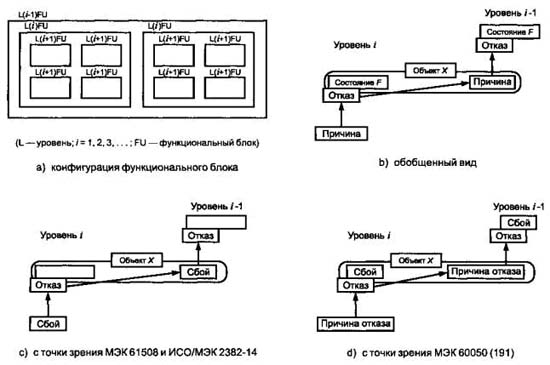
[ ГОСТ Р МЭК 61508-4-2007]Тематики
- газораспределение
- надежность средств электросвязи
- надежность, основные понятия
Обобщающие термины
EN
сброс
Разрывное нарушение, при котором сместитель падает в сторону опущенного крыла (висячее крыло опущено относительно лежачего).
[ Словарь геологических терминов и понятий. Томский Государственный Университет]Тематики
- геология, геофизика
Обобщающие термины
EN
сверхток
Любой ток, превышающий номинальный
МЭК 60050(441-11-06).
[ ГОСТ Р 50030. 1-2000 ( МЭК 60947-1-99)]
[ ГОСТ Р 50345-99( МЭК 60898-95)]
сверхток
Электрический ток, превышающий номинальный электрический ток.
Сверхток представляет собой любой электрический ток, величина которого превышает номинальный ток какого-либо элемента электроустановки здания или используемого в ней электрооборудования, например: номинальный ток электрической цепи, допустимый длительный ток проводника, номинальный ток автоматического выключателя и т. д. В нормативной и правовой документации различают два основных вида сверхтока – ток перегрузки и ток короткого замыкания.
Появление сверхтока в каком-либо элементе электроустановки здания может привести к его перегреву, возгоранию и, как следствие, к возникновению пожара в здании. Поэтому в электроустановках зданий выполняют защиту от сверхтока.
[ http://www.volt-m.ru/glossary/letter/%D1/view/59/]
сверхток
сверхток в электротехническом изделии
Ток, значение которого превосходит наибольшее рабочее значение тока электротехнического изделия (устройства).
[ ГОСТ 18311-80]
сверхток
Электрический ток, превышающий номинальный электрический ток.
Примечание - Для проводников номинальный ток считается равным длительному допустимому току.
[ ГОСТ Р МЭК 60050-826-2009]
Сверхток может оказывать или может не оказывать вредные воздействия в зависимости от его величины и продолжительности. Сверхтоки могут возникать в результате перегрузок в электроприемниках или при повреждениях, таких как короткие замыкания или замыканиях на землю
[ ГОСТ Р 50571. 1-2009 ( МЭК 60364-1: 2005)]
сверхток
Любой ток, превышающий номинальное значение. Для проводов номинальным значением является допустимый ток.
[ ГОСТ Р МЭК 60204-1-2007]EN
overcurrent
electric current exceeding the rated electric current
NOTE – For conductors, the rated current is considered as equal to the current-carrying capacity
[IEV number 826-11-14]
over-current
<>current exceeding the rated current
<>[IEC 61095, ed. 2.0 (2009-02)]
over-current
electric current the value of which exceeds a specified limiting value
[IEV number 151-15-28]
[IEV number 442-01-20]FR
surintensité, f
courant électrique supérieur au courant électrique assigné
NOTE – Pour des conducteurs, on considère que le courant assigné est égal au courant admissible.
[IEV number 826-11-14]
surintensité
courant supérieur au courant assigné
[IEC 61095, ed. 2.0 (2009-02)]
[IEV number 442-01-20]
surintensité, f
courant électrique dont la valeur dépasse une valeur limite spécifiée
[IEV number 151-15-28]Параллельные тексты EN-RU The design of LV installations leads to basic protection devices being fitted for three types of faults:
-
overloads
-
short-circuits
-
insulation faults
Низковольтные электроустановки должны быть оснащены устройствами защиты трех типов:
-
от перегрузки;
-
от короткого замыкания;
- от токов утечки.
[Перевод Интент]
Примечание.
Слово fault в данном случае пришлось опустить, поскольку:
- его нельзя перевести как "неисправность", т. к. возникновение перегрузки ( overload) не является неисправностью;
- его нельзя перевести как "сверхток", т. к. ток утечки не является сверхтоком.The chosen switchgear must withstand and eliminate faults at optimised cost with respect to the necessary performance.
[Schneider Electric]Выбранная аппаратура распределения должна иметь такие характеристики, чтобы рентабельно выдерживать и ограничивать сверхтоки.
[Перевод Интент]Тематики
Синонимы
EN
DE
FR
ток повреждения
Ток, возникающий в результате пробоя или перекрытия изоляции.
[ ГОСТ Р 51321. 1-2000 ( МЭК 60439-1-92)]
ток повреждения
Ток, который протекает через данную точку повреждения в результате повреждения изоляции.
[ ГОСТ Р МЭК 60050-826-2009]EN
fault current
current resulting from an insulation failure, the bridging of insulation or incorrect connection in an electrical circuit
[IEC 61439-1, ed. 2.0 (2011-08)]
fault current
current which flows across a given point of fault resulting from an insulation fault
[IEV number 826-11-11]FR
courant de défaut
courant résultant d'un défaut de l'isolation, du contournement de l’isolation ou d’un raccordement incorrect dans un circuit électrique
[IEC 61439-1, ed. 2.0 (2011-08)]
courant de défaut, m
courant s'écoulant en un point de défaut donné, consécutivement à un défaut de l'isolation
[IEV number 826-11-11]Тематики
EN
DE
- Fehlerstrom, m
FR
- courant de défaut, m
3.7.2 повреждение (fault): Повреждение любого элемента, разделения, изоляции или соединения между элементами, не являющимися по настоящему стандарту не повреждаемыми, от которых зависит искробезопасность цепи.
Источник: ГОСТ Р 52350.11-2005: Электрооборудование для взрывоопасных газовых сред. Часть 11. Искробезопасная электрическая цепь "I" оригинал документа
3.16 неисправность (fault): Состояние объекта, характеризующееся неспособностью исполнять требуемую функцию, исключая время профилактического технического обслуживания или других запланированных действий, или простои из-за недостатка внешних ресурсов
Примечание - Неисправность часто является результатом отказа объекта, но может существовать и без отказа.
Источник: ГОСТ Р 51901.6-2005: Менеджмент риска. Программа повышения надежности оригинал документа
3.6 неисправность (fault): Состояние элемента, характеризующееся неспособностью исполнять требуемую функцию, исключая период технического обслуживания, ремонта или других запланированных действий, а также из-за недостатка внешних ресурсов.
Примечание - Неисправность часто является результатом отказа элемента, но может существовать и без предшествующего отказа.
Источник: ГОСТ Р 51901.5-2005: Менеджмент риска. Руководство по применению методов анализа надежности оригинал документа
3.5 неисправность (fault): Состояние объекта, когда один из его элементов или группа элементов проявляют признаки деградации или нарушения работы, что может привести к отказу машины.
Примечания
1 Неисправность часто является следствием отказа, но может иметь место и при его отсутствии.
2 Состояние объекта не рассматривают как неисправное, если оно возникло вследствие запланированных процедур или нехватки внешних ресурсов.
Источник: ГОСТ Р ИСО 13379-2009: Контроль состояния и диагностика машин. Руководство по интерпретации данных и методам диагностирования оригинал документа
3.3 неисправность (fault): Состояние объекта, при котором он не способен выполнять требуемую функцию, за исключением такой неспособности при техническом обслуживании или других плановых мероприятиях или вследствие нехватки внешних ресурсов.
Примечания
1 Неисправность часто является следствием отказа объекта, но может иметь место и без него.
2 В настоящем стандарте термин «неисправность» используется наряду с термином «отказ» по историческим причинам.
Источник: ГОСТ Р 51901.12-2007: Менеджмент риска. Метод анализа видов и последствий отказов оригинал документа
3.1.30 ошибка (fault): Разность между погрешностью весоизмерительного датчика и основной погрешностью весоизмерительного датчика (см. 3.1.34).
Источник: ГОСТ Р 8.726-2010: Государственная система обеспечения единства измерений. Датчики весоизмерительные. Общие технические требования. Методы испытаний оригинал документа
3.6 дефект (fault): Неисправность или ошибка в компоненте технического обеспечения, программного обеспечения или системы
[МЭК 61513, пункт 3.22]
Примечание 1 - Дефекты могут подразделяться на случайные, например, в результате ухудшения аппаратных средств из-за старения, и систематические, например, ошибки в программном обеспечении, которые вытекают из погрешностей проектирования.
Примечание 2 - Дефект (в особенности дефект проекта) может остаться необнаруженным в системе до тех пор, пока не окажется, что полученный результат не соответствует намеченной функции, то есть возникает отказ.
Примечание 3 - См. также «ошибка программного обеспечения» и «случайный дефект».
Источник: ГОСТ Р МЭК 62340-2011: Атомные станции. Системы контроля и управления, важные для безопасности. Требования по предотвращению отказов по общей причине оригинал документа
3.2 неисправность (fault): Состояние объекта, когда один из его элементов или группа элементов проявляет признаки деградации или нарушения работы, что может привести к отказу машины.
Примечание - Неисправность может привести к отказу.
Источник: ГОСТ Р ИСО 17359-2009: Контроль состояния и диагностика машин. Общее руководство по организации контроля состояния и диагностирования оригинал документа
3.17 дефект (fault): Неисправность или ошибка в компоненте технического обеспечения, программного обеспечения или системы.
[МЭК 61513, пункт 3.22]
Источник: ГОСТ Р МЭК 60880-2010: Атомные электростанции. Системы контроля и управления, важные для безопасности. Программное обеспечение компьютерных систем, выполняющих функции категории А оригинал документа
3.6.1 сбой (fault): Ненормальный режим, который может вызвать уменьшение или потерю способности функционального блока выполнять требуемую функцию.
Примечание - МЭС 191-05-01 определяет «сбой» как состояние, характеризуемое неспособностью выполнить необходимую функцию, исключая неспособности, возникающие во время профилактического ухода или других плановых мероприятий, либо в результате недостатка внешних ресурсов. Иллюстрация к этим двум точкам зрения показана на рисунке 4 [ИСО/МЭК 2382-14-01-10].
Источник: ГОСТ Р МЭК 61508-4-2007: Функциональная безопасность систем электрических, электронных, программируемых электронных, связанных с безопасностью. Часть 4. Термины и определения оригинал документа
3.22 дефект (fault): Дефект в аппаратуре, программном обеспечении или в компоненте системы (см. рисунок 3).
Примечание 1 -Дефекты могут быть результатом случайных отказов, которые возникают, например, из-за деградации аппаратуры в результате старения; возможны систематические дефекты, например, в результате дефектов в программном обеспечении, возникающих из-за ошибок при проектировании.
Примечание 2 - Дефект (особенно дефекты, связанные с проектированием) может оставаться незамеченным, пока сохраняются условия, при которых он не отражается на выполнении функции, т.е. пока не произойдет отказ.
Примечание 3 - См. также «дефект программного обеспечения».
Источник: ГОСТ Р МЭК 61513-2011: Атомные станции. Системы контроля и управления, важные для безопасности. Общие требования оригинал документа
4.10.1 ошибка (fault): Разность между погрешностью показаний и погрешностью прибора.
Источник: ГОСТ Р ЕН 1434-1-2011: Теплосчетчики. Часть 1. Общие требования
Англо-русский словарь нормативно-технической терминологии > fault
См. также в других словарях:
Disease management (health) — Disease management is defined as a system of coordinated health care interventions and communications for populations with conditions in which patient self care efforts are significant. [1][2][3] For people who can access health care… … Wikipedia
Disease Models & Mechanisms — Abbreviated title (ISO) … Wikipedia
Basic metabolic panel — Diagnostics LOINC 24320 4, 24321 2, 51990 0 A basic metabolic panel (BMP) is a set of seven or eight blood chemical … Wikipedia
Basic education — refers to the whole range of educational activities taking place in various settings (formal, non formal and informal), that aim to meet basic learning needs. According to the International Standard Classification of Education (ISCED), basic… … Wikipedia
Basic Occupational Health Services — The Basic Occupational Health Services are an application of the primary health care principles in the sector of occupational health. Primary health care definition can be found in the World Health Organization Alma Ata declaration from the year… … Wikipedia
Basic reproduction number — In epidemiology, the basic reproduction number (sometimes called basic reproductive rate or basic reproductive ratio) of an infection is the mean number of secondary cases a typical single infected case will cause in a population with no immunity … Wikipedia
basic research — Research Re*search (r? s?rch ), n. [Pref. re + search: cf OF. recerche, F. recherche.] 1. Diligent inquiry or examination in seeking facts or principles; laborious or continued search after truth; as, researches of human wisdom; to research a… … The Collaborative International Dictionary of English
cardiovascular disease — Introduction any of the diseases, whether congenital or acquired, of the heart and blood vessels (blood vessel). Among the most important are atherosclerosis, rheumatic heart disease, and vascular inflammation. Cardiovascular diseases are a … Universalium
Health and Disease — ▪ 2009 Introduction Food and Drug Safety. In 2008 the contamination of infant formula and related dairy products with melamine in China led to widespread health problems in children, including urinary problems and possible renal tube… … Universalium
human disease — Introduction an impairment of the normal state of a human being that interrupts or modifies its vital functions. health versus disease Before human disease can be discussed, the meanings of the terms health, physical fitness, illness … Universalium
Mathematical modelling of infectious disease — It is possible to mathematically model the progress of most infectious diseases to discover the likely outcome of an epidemic or to help manage them by vaccination. This article uses some basic assumptions and some simple mathematics to find… … Wikipedia
